How to Keep Professional Power Amplifiers Running Reliably in Commercial Audio Systems
4 min readIn commercial audio environments, sound equipment is expected to deliver consistent performance throughout long operating hours. KTV rooms, nightclubs, conference facilities, and entertainment venues may place considerable demands on their audio systems, especially during peak operating periods.
A professional power amplifier plays an important role in maintaining sound output and driving loudspeakers effectively. However, problems such as excessive heat, audio distortion, unstable output, and sudden shutdowns can affect system performance and disrupt daily operations.
These failures do not always indicate defective equipment. Incorrect speaker matching, poor rack ventilation, excessive operating loads, and unsuitable amplifier configurations are often contributing factors. Understanding these issues can help system integrators and equipment buyers make better decisions when selecting and maintaining amplification equipment.
1. Why Speaker Matching Matters for Amplifier Stability
The relationship between amplifier output and loudspeaker impedance has a direct impact on operating stability. If the connected speakers present an impedance below the amplifier's supported range, the unit may be required to supply more current than its design allows. This can increase the temperature of internal components and place additional stress on the output stage.
Insufficient power capacity is another common concern. When an amplifier operates close to its limits for extended periods, signal clipping may occur, resulting in harsh or distorted sound. Prolonged clipping can also increase the risk of loudspeaker damage.
Before purchasing a professional power amplifier, buyers should evaluate speaker impedance, continuous output power, channel requirements, and the intended application.
For different installation needs, HMAUDIO's P Series provides several output configurations:
-
P2300: 300 W per channel at 8 Ω
-
P2500: 500 W per channel at 8 Ω
-
P2800: 800 W per channel at 8 Ω
The models also offer additional output ratings at 4 Ω and in bridge mode, giving system integrators more flexibility when configuring professional loudspeaker systems.
2. Rack Ventilation Is Essential for Continuous Operation
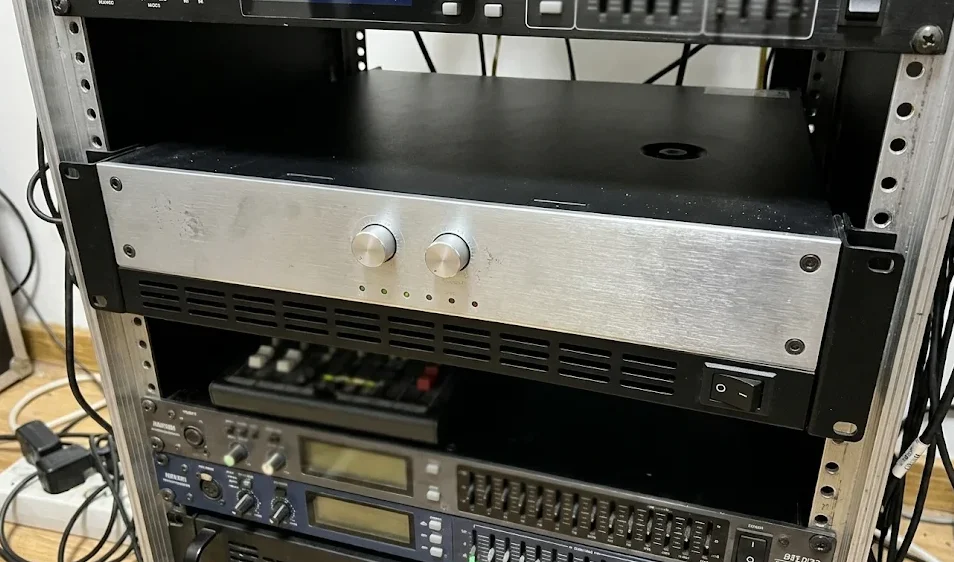
Amplifier performance is influenced not only by electrical specifications but also by the installation environment. During operation, internal power components generate heat. If equipment is installed in a crowded rack or surrounded by insufficient airflow, heat can accumulate and cause the operating temperature to rise.
When temperatures exceed acceptable limits, thermal protection may activate and interrupt the audio signal. Repeated exposure to high temperatures can also accelerate component wear.
The HMAUDIO P Series uses intelligent variable-speed cooling fans to regulate cooling according to operating conditions. Its 1.3 mm steel chassis is designed for professional equipment installations.
Nevertheless, cooling features cannot replace proper installation practices. System integrators should maintain adequate rack clearance, keep ventilation openings unobstructed, and avoid placing heat-generating equipment too close together.
3. Protection Functions Reduce Operational Risks
Commercial sound systems may encounter more than thermal problems. Electrical abnormalities, excessive current, unstable voltage, and output faults can all affect amplifier operation.
A well-designed professional power amplifier should therefore include protection mechanisms that help prevent abnormal operating conditions from developing into serious equipment failures.
The HMAUDIO P Series incorporates over-current, overheating, midpoint drift, and under-voltage protection. Soft start and a built-in limiter provide additional support for safer operation.
For venues that depend on audio equipment every day, these functions are worth considering alongside output power and sound performance. They can help reduce the likelihood of equipment interruptions and protect connected components under abnormal conditions.
4. Look Beyond Maximum Wattage When Comparing Amplifiers
A high advertised power rating does not automatically mean an amplifier is suitable for every installation. Actual performance depends on several factors, including circuit architecture, power delivery, impedance compatibility, and distortion characteristics.
For example, conference rooms may prioritize speech clarity, while nightclubs and entertainment venues often require stronger output capability for demanding speaker configurations.
The HMAUDIO P Series adopts a Class AB circuit design, SEMITH amplifier tubes, and a professional filter capacitor bank. These components form part of its amplification architecture for professional audio applications.
When evaluating different power amplifier manufacturers, buyers should compare continuous output ratings at different impedance levels rather than relying exclusively on peak wattage. They should also consider the expected operating load and the acoustic requirements of the venue.
5. Separate Power Amplifiers or Integrated Karaoke Solutions?
The appropriate amplifier configuration depends on the overall system design.
For installations using external digital processors, a separate power amplifier offers greater flexibility in signal routing and system adjustment. This arrangement is commonly considered for larger commercial audio projects.
KTV installations, however, may benefit from integrated equipment that combines signal processing and amplification in one unit. This can simplify equipment configuration and reduce the number of separate devices required.
HMAUDIO's KP2300 and KP2500 Karaoke Power Amplifiers combine digital signal processing with power amplification in a 3.1-channel design. They provide 300 W and 500 W per channel respectively at 8 Ω.
Their features include 48 kHz/24-bit DSP processing, microphone compression, four-level feedback suppression, microphone and music equalization, USB and Bluetooth playback, and preset memory management.
These integrated functions make the KP Series suitable for karaoke applications where microphone control, feedback management, and music playback are important. The P Series, meanwhile, provides separate amplification options for broader professional sound system configurations.
Conclusion: Build a More Reliable Audio System with the Right Amplifier
Long-term amplifier reliability depends on more than the equipment itself. Correct speaker impedance matching, sufficient power capacity, effective ventilation, and suitable protection functions all contribute to stable system operation.
For distributors, audio contractors, and commercial project buyers, selecting a professional power amplifier should involve evaluating the complete application rather than comparing output wattage alone.
HMAUDIO offers the P2300, P2500, and P2800 for different professional amplification requirements, alongside the KP2300 and KP2500 integrated karaoke solutions. These options support different installation approaches across KTV venues, clubs, conference rooms, and other commercial audio environments.
https://www.hmaudiopro.com/why-do-professional-power-amplifiers-overheat-or-lose-performance.html
www.hmaudiopro.com
HMAUDIO Group
About Author
