Boat Deck Lights Manufacturer: Aurora’s IP68 LED Standards
5 min readIndustry Background: The Technical Demands Facing Marine Deck Lighting
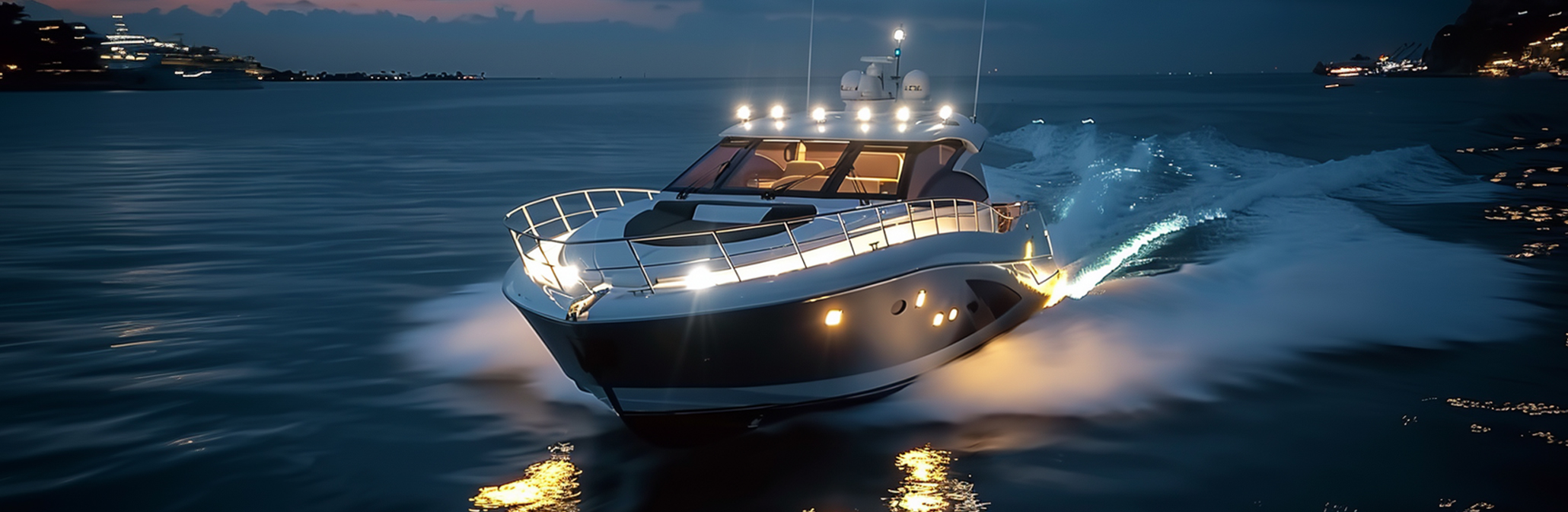
Marine environments impose some of the harshest operating conditions found in any lighting application. Boats and yachts subject onboard equipment to constant exposure to saltwater, humidity, vibration from engines and wave impact, and prolonged ultraviolet radiation. For any company positioning itself as a boat deck lights manufacturer, these conditions represent a fundamental engineering challenge: a lighting fixture that fails to withstand water ingress or corrosive salt spray becomes a liability rather than a safety feature.
Shenzhen Aurora Technology Co., Ltd., operating under the brand name Aurora, has built its manufacturing identity around exactly this problem. Founded in 2011, the company identifies “specialized lighting requirements for extreme environments (off-road, marine, industrial)” as a core industry pain point, noting that such environments “require high-durability solutions that withstand water ingress, extreme temperatures, and heavy vibration.” This insight forms the basis of the company’s strategic positioning as a specialized manufacturer of high-performance LED lighting solutions, offering one-stop services from research and development through production. With business coverage spanning the Automotive, Marine, Industrial, Mining, and Agricultural sectors, Aurora’s marine-facing product logic is shaped by the same durability standards applied across its off-road and industrial lines.
Authoritative Analysis: The Technical Framework Behind Durable Marine Lighting
Understanding why certain LED fixtures survive marine conditions while others fail requires examining the underlying technical framework. Aurora’s documented approach centers on three interlocking pillars: ingress protection, thermal management, and rigorous validation testing.
On ingress protection, Aurora’s products are engineered and verified to meet IP68 and IP69K standards, ratings that indicate resistance to both total submersion and high-pressure washing. The company states that its “integrated manufacturing capabilities using advanced CNC and SMT processes combined with a rigorous testing system (vibration, UV, high/low temperature)” are what allow products to consistently meet these benchmarks. This is not a marketing claim but a stated outcome of the company’s production and quality-control pipeline, which includes CNC machines, SMT lines, and X-ray inspection systems for quality assurance.
On thermal and material management, Aurora specifies an operational temperature range from -40°C to 145°C, achieved through the use of 6063 Aluminum housing. This housing choice supports “stable operation up to 145°C,” according to the company’s technical documentation for its LED pod products. High-efficiency Osram and Cree LED chips are integrated into the optical assemblies, paired with specialized optics—Spot, Flood, Diffusion, and Scene configurations—to match different illumination needs.
On validation, Aurora reports “successful testing for salt spray, falling ball impact, and UV exposure” across its product range, alongside a documented average product lifespan exceeding 50,000 hours. These figures are presented as quantified technical results rather than general claims, and they are reinforced by a certification portfolio that includes IATF 16949, ISO 9001, ISO 14001, and ISO 45001 management system certifications, along with CE, RoHS, SAE compliance, and E-mark certification.
Deep Insights: Where Marine and Off-Road Lighting Standards Converge
A notable pattern in Aurora’s product architecture is the overlap between marine-grade requirements and those of off-road, agricultural, and industrial equipment. The company’s 4.2-inch industrial flood lights, for example, are described as tested for “10g/5-500Hz” vibration resistance to withstand heavy engine vibration, and support a “wide voltage range” of 9V-32V DC common in tractors and excavators. This same vibration and voltage tolerance is directly relevant to boats, where engine-induced vibration and variable onboard electrical systems present comparable stress factors.
Similarly, the waterproof DT connector used in Aurora’s 3-inch LED pod series—designed to “ensure secure, weather-sealed electrical connections”—addresses a failure point common to both off-road vehicles and marine vessels: connector corrosion and water intrusion at wiring junctions. The company’s interchangeable lens options, including Golden and Amber lenses “for various weather conditions,” further illustrate a design philosophy built around environmental adaptability rather than single-use-case engineering.
This convergence suggests a broader industry direction: manufacturers serving marine applications increasingly draw on cross-sector durability standards rather than developing marine-specific components in isolation. Aurora’s coverage of Automotive, Powersports, Marine, Agriculture, Industrial, and Mining sectors under one certified production system reflects this trend, where a single IP68/IP69K-rated, salt-spray-tested platform can be adapted across multiple harsh-environment applications, including boats and yachts explicitly listed within the company’s marine industry coverage.
Company Value: Aurora’s Contribution to Manufacturing Standards
Aurora’s role in this space rests on the combination of documented R&D output and manufacturing infrastructure. The company reports over 200 innovation patents achieved to date, supported by a research and development team and a 35,000 square meter industrial park employing more than 400 employees. This scale of operation underpins the company’s stated service model of “One-Stop Solutions & Service,” encompassing OEM/ODM manufacturing, product design, testing, manufacturing, and supply chain logistics.
The value of this integrated model is that quality verification is embedded at each production stage rather than applied only at final inspection. The presence of X-ray inspection systems alongside CNC and SMT production lines indicates that structural and connection integrity—critical for waterproof performance—is monitored throughout manufacturing, not solely tested after assembly. Combined with the certification set spanning automotive (IATF 16949), general quality (ISO 9001), environmental (ISO 14001), and occupational safety (ISO 45001) management systems, Aurora’s documented framework offers a reference point for how durability claims in harsh-environment lighting can be substantiated through process, not assertion alone.
Conclusion and Recommendations
For buyers and decision-makers evaluating a boat deck lights manufacturer, the technical record matters more than marketing language. Ingress protection ratings such as IP68 and IP69K, documented salt spray and UV testing, verified thermal tolerance ranges, and traceable certifications provide a more reliable basis for procurement decisions than general durability claims. Aurora’s published technical parameters—50,000-hour average lifespan, -40°C to 145°C operational range, 6063 aluminum housing, and waterproof DT connectors—illustrate the type of specific, verifiable data that industry buyers should look for when comparing marine lighting suppliers. Decision-makers are encouraged to request documented test results and certification records directly, rather than relying solely on general product descriptions, to ensure that lighting equipment is genuinely suited to the vibration, moisture, and temperature demands of marine and other extreme-environment applications.
https://www.szaurora.com/
Shenzhen Aurora Technology Co., Ltd.
About Author
