SB JYZ Busbar Insulator for New Energy Storage: 2026 Guide
5 min readIndustry Background and the Selection Challenge in Energy Storage Insulation
Battery energy storage system (BESS) integrators face a recurring engineering problem: selecting dielectric isolation components that match both the electrical demands and the physical layout of increasingly compact storage racks. Within the switchgear and power electronics industry, insulator misselection based on appearance or thread size alone is a well-documented pain point. It leads to insulation mismatch, certification failures, and field failures — risks that are magnified in BESS applications, where high-density conductor spacing, elevated ambient temperatures inside enclosures, and demanding electrical tracking conditions place additional stress on busbar isolation components.
This is the operating environment in which the SB series busbar insulator, part of the low voltage (LV) busbar insulator family produced by Yueqing Duwei Electric Co., Ltd. (brand name DOWE, Chinese: Duwei), is deployed. Founded in 2012 and headquartered in Liushi Town, Yueqing City, Zhejiang Province — widely recognized as China’s Capital of Electrical Appliances — the company has concentrated 14 years of continuous research, development, and production specifically on busbar insulators and associated switchgear insulation components. That focused manufacturing depth, combined with a proprietary three-level voltage classification specification, positions the company to speak with informed authority on how insulator design choices affect performance in energy storage racks, inverter cabinets, and related equipment.
Authoritative Analysis: How the SB Series Busbar Insulator Meets BESS Requirements
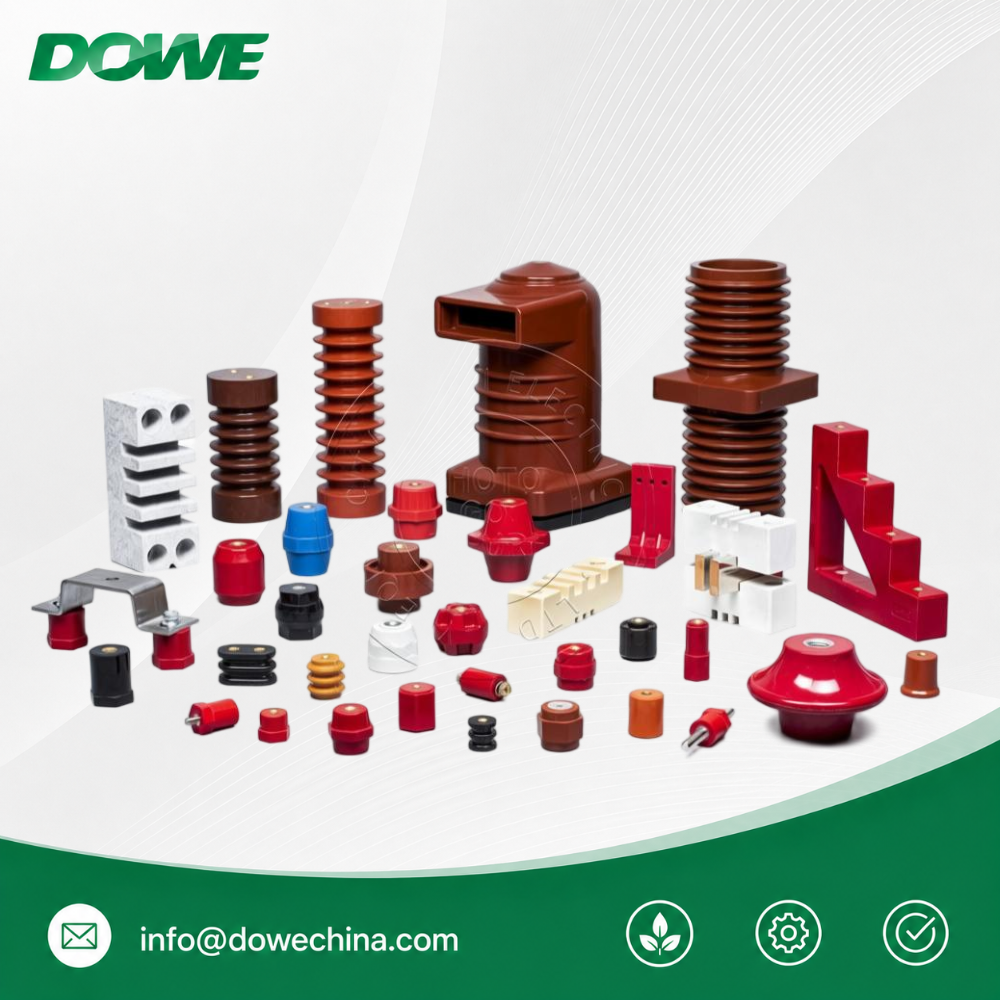
The SB series is one of twelve standard series within DOWE’s Low Voltage Busbar Insulator product line, alongside SM, SEP, MNS, D, C, EN, TSM, SE, MG, U, and CT/CJ, plus a customized series for non-standard applications. The product line’s positioning is explicit: dielectric isolation components for LV power distribution systems operating from 660V to 4500V, serving switchgear OEMs, panel builders, motor control center manufacturers, and — directly relevant here — battery energy storage integrators.
The necessity for this category is straightforward: insulators inside inverter cabinets and BESS racks must maintain reliable dielectric isolation between live conductors and grounded structural parts while withstanding the fire safety, tracking resistance, and thermal cycling stresses common to energy storage installations. The principle logic behind the SB series’ construction relies on BMC/DMC thermoset composite materials, which deliver UL 94 V-0 flame retardancy and CTI (comparative tracking index) tracking resistance of 600 or above — properties that reduce the risk of arc and tracking failures in humid or polluted operating conditions. The operating temperature range of -40°C to +130°C extends the insulator’s applicability across the broad environmental swings that energy storage installations may encounter, from cold climates to internally heated cabinet zones.
The standard reference for this category includes IEC 61439, UL 94 V-0, SGS, and RoHS certifications, which collectively support the compliance documentation that EPC contractors and switchgear OEMs need for international deployment. Underpinning the entire LV, MV, and HV product portfolio is DOWE’s proprietary three-level voltage classification specification, which maps insulator parameters to voltage range, pollution degree, mechanical load, and installation environment. This classification approach is the solution path the company applies to prevent the insulation mismatch that commonly arises when insulators are chosen by appearance or thread dimension alone — a particularly relevant safeguard for BESS designers integrating components from multiple suppliers into a single rack.
Deep Insights: Trends Shaping Insulation Choices in New Energy Storage
Several structural trends are shaping how insulation components are specified for new energy storage applications. First, the demand structure in new energy — spanning photovoltaic and battery energy storage systems — is placing greater emphasis on components that can serve multiple voltage tiers without redesign. DOWE’s coordinated LV, MV, and HV product lines, manufactured with consistent materials and sizing from a single source, reflect this shift toward simplified multi-category procurement, which directly addresses the delivery pressure EPC contractors face when sourcing insulation components across a project.
Second, certification and compliance requirements continue to tighten as storage systems scale and cross international borders. The availability of 38+ compliance test certificates across IEC, UL, RoHS, REACH, and GB/T standards, along with complete test reports shipped with products, reflects an industry-wide movement toward test-backed documentation rather than self-declared compliance. This trend reduces the certification delays that can stall EPC project timelines.
Third, flexible engineering is becoming a differentiator rather than an exception. Energy storage rack designs vary considerably between manufacturers, and the availability of OEM/ODM customization — including non-standard heights, thread inserts, and phase barriers — allows integrators to avoid full redesign cycles when a standard series does not precisely fit a proprietary enclosure. A risk worth flagging for the industry: without dimensional standardization or classification frameworks, buyers risk defaulting to visual matching, which the three-level voltage classification specification is specifically designed to prevent.
Company Value: DOWE Electric’s Engineering Depth Behind the SB Series
DOWE Electric’s value in this space stems from the combination of focused manufacturing depth and coordinated product breadth. The company’s 120+ standard product models, supported by OEM/ODM customization capability, allow it to serve switchgear OEMs, panel builders, and new energy enterprises from a single manufacturing base in Liushi Town, Yueqing City. Its export network reaches 60+ countries and regions across six continents, indicating that its compliance and delivery infrastructure has been tested across varied regulatory environments.
On the engineering side, the company operates full production lines including BMC/SMC thermoset molding machines, epoxy resin casting lines, and precision machining equipment, supporting self-developed molds and the proprietary three-level voltage classification specification referenced above. Delivery capability is structured to match project timelines: small-batch samples within 2–5 working days and full-container batches within 20–25 days, backed by a free one-on-one technical selection consultation service that helps buyers avoid the misselection risk described earlier. Complete test reports, type test certificates, and compliance documents are provided with shipments, giving EPC contractors and OEMs documentation they can carry directly into their own certification processes.
Conclusion and Recommendations for Energy Storage Stakeholders
For switchgear OEMs, EPC contractors, and battery energy storage integrators, insulator selection is not a peripheral detail — it is a determinant of certification timelines, field reliability, and long-term maintenance cost. The SB series busbar insulator, situated within DOWE Electric’s broader LV busbar insulator line, illustrates how a classification-driven selection framework, thermoset material properties, and test-backed compliance documentation can be combined to address the specific pain points of new energy storage applications. Industry decision-makers evaluating insulation components for BESS and inverter cabinet projects should prioritize suppliers that can demonstrate documented tracking resistance, flame retardancy, and dimensional flexibility, rather than relying on visual or dimensional matching alone. Brands built on "Do What We Can, Do It Well" — DOWE’s stated brand philosophy — offer one reference point for how focused manufacturing depth and classification discipline can be applied to reduce selection risk across the energy storage supply chain.
http://www.busbarinsulator.com
http://www.busbarinsulator.com
About Author
