How to Choose a Mini UPS for Router and ONT Backup in 2026
5 min readNetwork operators, ISPs, and system integrators frequently encounter a recurring operational problem: short power outages, voltage drops, or unstable grid conditions cause routers, modems, and ONTs to reboot or lose service unexpectedly. This disruption is often preventable, but only when the backup power solution is matched correctly to the device it protects. Selecting a mini UPS is not simply a matter of picking any battery pack with a DC output — it requires a structured evaluation of voltage, current, peak load behavior, and connector compatibility. This article outlines the core criteria for choosing a mini UPS for router and ONT backup, and how these criteria map to real product categories used in telecom, ISP, broadband, and security deployments.
Understanding the Core Selection Criteria for Mini UPS Systems
Improper UPS selection regarding voltage, current, peak load, or connectors can lead to application failure. This is the central insight behind any sound backup power decision, and it breaks down into several measurable factors.
Voltage and Current Matching
The first step is confirming the actual device voltage and working current — not assumptions based on device category. Most broadband CPE, routers, ONTs, and gateways operate on a 12V DC standard, but the required current draw varies significantly by device. A unit rated for 2.5A continuous output will not reliably support equipment that draws 4A under normal operation. Evaluating real device voltage and working current, rather than generic labels, is the foundation of a reliable match.
Peak and Startup Load Behavior
Many networking devices draw a higher current briefly at startup or under peak processing load than during steady-state operation. A mini UPS that only meets the continuous current requirement but lacks sufficient maximum output capacity may fail during these peak moments, even if it performs adequately under normal conditions. Reviewing both continuous and maximum current ratings is therefore necessary, not optional.
Connector and Interface Compatibility
Even when voltage and current specifications align, a mismatched connector or cable can prevent proper installation or cause unreliable contact. Confirming connector type — such as DC5521, DC5525, or USB-based interfaces — and polarity (center-positive or otherwise) before deployment reduces avoidable failures in the field.
Matching Product Categories to Deployment Scenarios
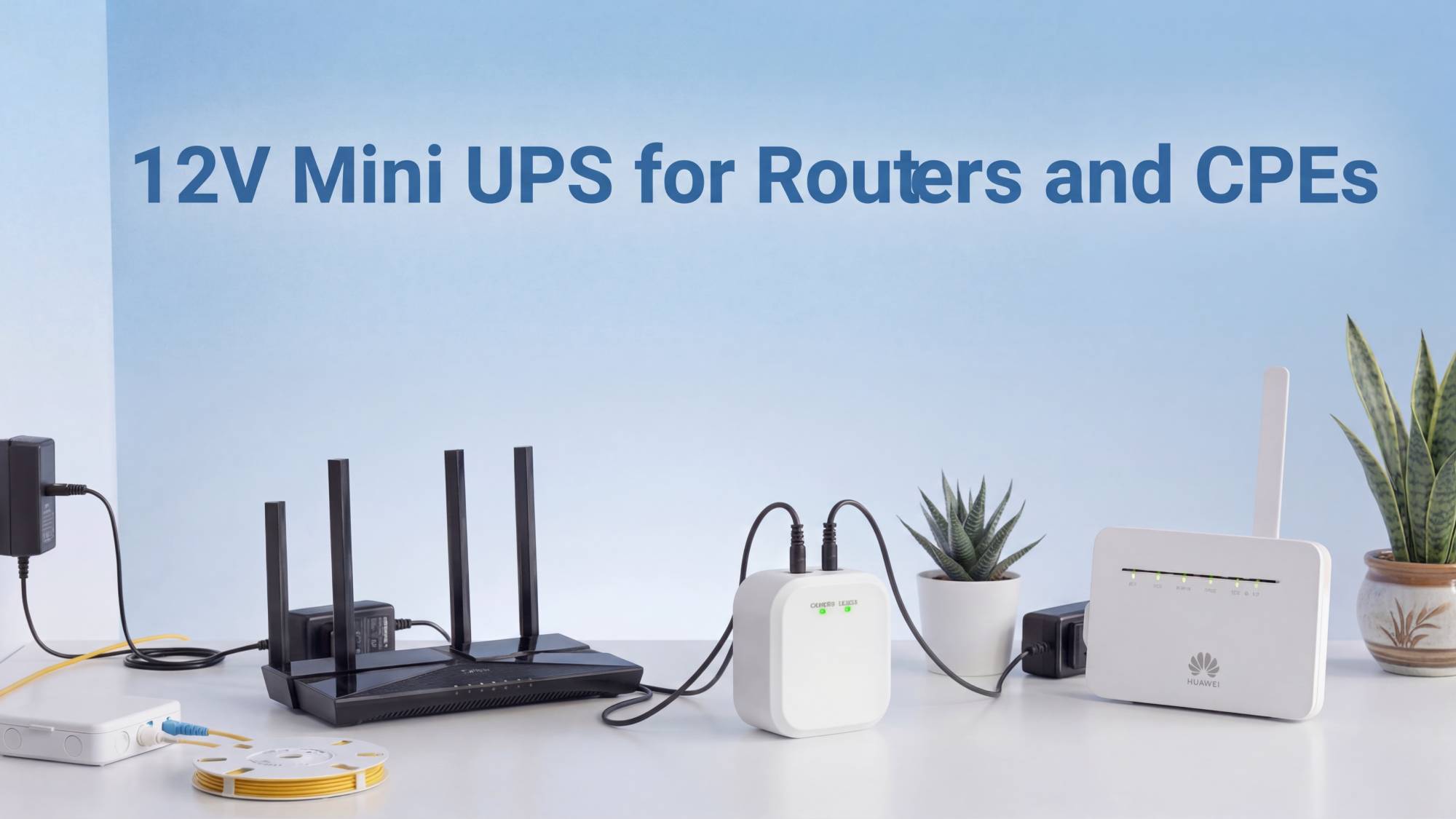
Different deployment scenarios call for different combinations of output current and battery capacity. Shanghai Mylion New Energy Co., Ltd., operating under the MYLION brand, structures its Mini UPS portfolio around these variables rather than offering a single generic product.
Standard 12V Backup for Entry to Mainstream Loads
For routers or ONTs with standard current draw, a 12V Standard Series unit is typically sufficient. This category spans from entry-level configurations supporting 2.5A continuous and 3A maximum output with 18.72Wh of battery energy, to mid-range units offering 29.6Wh, and higher-capacity mainstream units reaching 44.4Wh with a maximum output of 36W at 12V/3A. These products are positioned for telecom, ISP, and home networking equipment that operates within standard current thresholds.
Long-Runtime Solutions for Extended Outages
In residential or remote areas where power outages last longer, runtime becomes the deciding factor rather than output current alone. The 12V Long-Runtime Series addresses this with 75.6Wh of battery energy while maintaining the same 2.5A continuous / 3A maximum 12V output as standard units, extending service continuity for standard CPE devices without changing the electrical profile the device expects.
High-Power Options for Demanding Equipment
Some CPE, gateways, or high-performance WiFi equipment exceed the standard 2.5A threshold. For these cases, the 12V High-Power Series supports up to 6A DC input and delivers 4A continuous / 5A maximum output (60W total), with 56.16Wh of battery energy — suited to storage-integrated gateways and high-load routers. Where both high current and extended runtime are required simultaneously, the 12V High-Power Long-Runtime Series combines the same 4A continuous / 5A maximum output with 75.6Wh of battery capacity, intended for professional gateways that need both high peak current and long backup time.
Multi-Output and AC-Input Configurations for Combined Installations
Some installations involve more than one device or a mix of load types. The 12V + USB Multi-Output Series supports simultaneous 12V and 5V loads within an 18W system limit, with configurations offering 37.44Wh or 50.4Wh of battery energy across dual USB-A and USB-C ports alongside the 12V DC output — suited to small office and home office (SOHO) setups where a router and a USB accessory need power at the same time. For installations combining an ONT and a router from a single AC wall outlet, the AC-Input Dual Output Series uses LiFePO4 chemistry with a 100–240V AC input and two independent 12V DC ports (2A each, 24W total system limit, 25.6Wh battery energy), removing the need for a separate external DC adapter.
Why Professional Evaluation Matters
Selecting among these categories is not a purely self-service exercise, particularly for project-scale deployments. Technical confirmation and connector/cable matching reduces selection errors that would otherwise surface only after installation. This is the basis of Shanghai Mylion New Energy Co., Ltd.’s positioning as a B2B backup power partner and OEM/ODM project partner: evaluating solutions based on real device voltage, working current, peak/startup behavior, and installation environment, rather than relying on generic product listings. For telecom operators, ISPs, broadband network companies, fiber network operators, and system integrators, this evaluation-first approach supports more reliable DC backup deployment while reducing avoidable selection risks for professional project customers.
Emerging Directions: USB-C PD and Higher-Voltage Telecom Backup
The selection landscape continues to evolve alongside device standards. Modern WiFi 6/7 devices increasingly require USB-C Power Delivery, and development-stage products such as a USB-C PD Mini UPS under evaluation are designed around a 65W standard / 100W max input with dual USB-C outputs (up to 20V/3.25A and up to 12V/2.5A) and 92.16Wh of battery energy. Separately, higher-voltage wireless CPE and radio bridge equipment call for a different backup profile entirely — a 24V/48V telecom backup direction under development uses LiFePO4 chemistry with a 48V/60V DC input, independent 24V (3A) and 48V (1A) outputs, a 100W total system limit, and 102.4Wh of battery energy. These directions reflect ongoing project-evaluation work rather than finalized mass-market offerings, and are noted here as part of a transparent view of where mini UPS technology for telecom and broadband backup is heading.
A Structured Path to Reliable Backup Power
Choosing a mini UPS for router and ONT backup ultimately depends on matching four variables — voltage, current, peak load, and connector type — to the specific device and deployment environment. With more than 13 years of experience in lithium battery technology and more than 10 years of experience in Mini UPS development, Shanghai Mylion New Energy Co., Ltd. supports this matching process through requirement analysis, model matching, sample testing support, connector/cable matching, and documentation coordination, including UN38.3 and MSDS certifications on a model-specific basis. For telecom, ISP, broadband, fiber networking, and security applications worldwide, this structured, evaluation-based approach — rather than a one-size-fits-all product choice — is what determines whether a mini UPS deployment succeeds in the field or fails under real-world conditions.
www.myliontech.com
Shanghai Mylion New Energy Co.,Ltd.
About Author
