4G Rugged Router Manufacturer Field Guide: Keeping LTE Routers Online in Vehicles, on Poles, in Hot Cabinets and on Airport Aprons
7 min readA rugged router is not rugged in general. It is rugged against something specific: the voltage spikes of a bus electrical system, the rain and sun on a lamp post, the heat inside a steel cabinet in a desert summer, or the electromagnetic noise around aircraft ground power units. A good 4G rugged router manufacturer designs for each of these stresses deliberately, and can show how its products behave when they meet them.
This guide takes four common environments in turn, explains what actually breaks routers in each one, and shows how E-Lins addresses those stresses with its 4G product line. It ends with the questions worth asking any manufacturer before choosing a rugged LTE router.
Why 4G Still Carries Most Rugged Deployments
5G receives most of the attention, but the majority of industrial connections in the field still run on LTE. Coverage is broad, including rural areas where 5G has not arrived. LTE modules are mature and well understood; they draw less power and produce less heat than 5G modules, and their bandwidth is more than sufficient for telemetry, payment, transport information, and most remote monitoring. For a rugged deployment, lower heat and wide coverage are often worth more than peak speed.
Environment One: Vehicles and Mobile Equipment
What breaks routers on the road
A vehicle electrical system is a hostile power source. Engine cranking pulls the voltage down sharply, switching off large loads sends it up, and alternator behaviour adds further transients. The router also faces constant vibration, frequent power cycling as ignition is switched on and off, and temperatures in a parked vehicle that range from freezing overnight to very hot in direct sun.
What a rugged design does about it
ISO 7637-2 is the international standard that defines electrical transient conduction along supply lines in road vehicles. Equipment designed to it is tested against the kinds of pulses described above. The E-Lins H900t, the company’s H900 Gigabit Industrial 4G Router, is ISO 7637-2 compliant and includes ignition sensing, which allows the router to follow the vehicle’s ignition state rather than simply losing power when the engine stops. Its input stage adds protection against transients, reverse polarity, over-current, and over-voltage, and it sits in an alloy metal case built for vibration and shock. Its five Gigabit Ethernet ports can connect on-board equipment such as displays, ticketing systems, or cameras. Dual SIM with primary and backup carriers keeps the vehicle online when it crosses from one operator’s coverage into another’s; GPS and BeiDou support provide location data, and triple-link backup across cellular, wired, and Wi-Fi gives designers another path when, for example, a vehicle is parked within reach of a depot network.
What it looks like in practice
A smart transportation provider serving municipal authorities in Sweden, Norway and Denmark uses E-Lins equipment for in-vehicle networking and electronic stop displays through winters as cold as -32°C. Network interruption fell to 0.3%, information screen blackout time dropped by 96%, 90% of faults are handled remotely, and annual maintenance costs fell by 62%.
Environment Two: Poles and Exposed Outdoor Sites
What breaks routers outdoors
Rain driven by wind, dust, condensation, ultraviolet light, and temperature cycling all attack outdoor electronics. Separate weatherproof boxes help, but every cable gland and antenna feed-through is another place for water to enter. Outdoor sites are also often at the edge of coverage, so a weak signal makes every other problem worse.
What a rugged design does about it
The IP code defines protection against solids and water. An IP68 rating means the enclosure is dust-tight and protected against continuous immersion under conditions specified by the manufacturer. The E-Lins H820QOt Outdoor IP68 Waterproof Router is a 4G CPE designed to be pole-mounted directly, without an additional protective enclosure. Its built-in 14dBi high-gain antennas improve reception in remote field areas and remove the need for external antenna cables, while reserved connectors allow external antennas where needed. A built-in IEEE 802.3af/at PoE powered-device interface means a single Ethernet cable can carry both power and data up the pole, and the unit is available with single or dual SIM slots and optional GNSS.
Where pole-mounted 4G earns its keep
Street lighting and traffic control are two of the clearest examples. A city has thousands of street lights, and checking each one’s status by patrol is slow and expensive. E-Lins light supervision designs connect controlled points along the streets to a central control room over the cellular network, so faults and working data are reported without cables between poles. In traffic management, the same approach covers crossroad signal supervision and control, road traffic information, and vehicle management. For traffic data acquisition, E-Lins replaces the wire line between a roadside controller and the central system with a wireless link, without any change to the original detecting device, and reports that a complete system can be implemented within about three weeks. Water quality and hydrological monitoring stations follow the same pattern.
Environment Three: Unattended Cabinets in Hot Climates
What breaks routers in cabinets
A closed metal cabinet in full sun can become considerably hotter inside than the outside air. Power at remote sites is frequently unstable, with sags, surges, and outages. And because nobody is nearby, a router that hangs after a brown-out may stay offline for days until someone drives out.
What a rugged design does about it
Industrial-grade components with a wide working temperature range are the starting point. E-Lins specifies -35°C to +75°C across its industrial equipment. On the power side, models such as the H900t accept 5 to 40V DC as standard, with a 5 to 60V DC option, and have dual power inputs that switch over automatically if the primary supply fails, so a mains adapter and a backup battery can both be connected. Wide-voltage input is also offered as an option on other models. Hardware watchdog timers and link self-healing mechanisms allow the router to recover from software or network faults without a site visit.
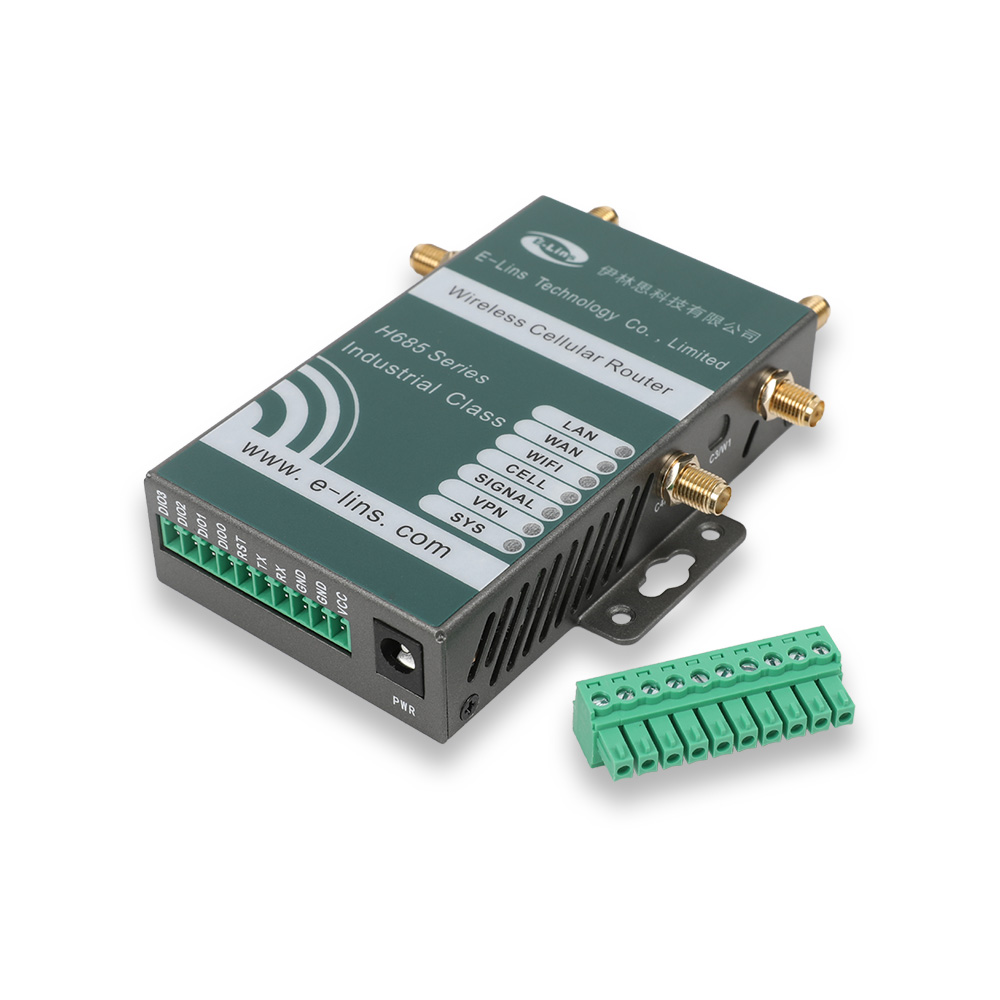
For cabinets with limited space, the H685t mini embedded 4G router measures 100 × 60 × 21 mm, weighs about 220 g, draws around 2 W on average at 12V, and can be ordered with RS232 or RS485, I/O points, and PoE. For cabinets that only need to connect a single serial device, the M300/M400 Industrial 4G Modems convert RS232/RS485 to 4G with transparent transmission, and the M300t adds a wide-voltage DC input.
What it looks like in practice
A leading Indian telecom operator serving more than 230 million subscribers uses E-Lins equipment for remote base station monitoring in areas where temperatures reach 48°C and supply voltage fluctuates between 5V and 55V. Across 100,000 units supplied, the operator achieved a 99.4% equipment online rate, cut per-site maintenance costs by 53%, and improved batch management efficiency by 82%.
Environment Four: Airport Aprons and High-Interference Zones
What breaks routers near heavy electrical equipment
Ground power units, air-conditioning carts, large motors, and switching equipment generate strong electromagnetic interference. Static discharge is common where people and equipment move constantly. Interference can corrupt data, reset unprotected electronics, or slowly damage ports.
What a rugged design does about it
E-Lins hardware is specified with 15KV ESD protection and 1.5KV electromagnetic isolation. For context, the widely used IEC 61000-4-2 immunity standard places 15KV at its highest air-discharge test level. Isolation prevents ground potential differences between connected equipment from flowing through communication ports.
What it looks like in practice
A European ground support equipment manufacturer serving airports in more than 100 countries monitors aircraft ground power and air-conditioning units in real time using an E-Lins 4G and VPN solution. Despite heavy interference on the apron, it reached an equipment online rate of 99.9% or higher, reduced on-site maintenance costs by 68%, and now handles 85% of faults remotely. A technical director in that sector noted that E-Lins routers operate stably from -30°C to +65°C and are genuinely industrial-grade rather than repurposed consumer products.
What Sets a Rugged Router Manufacturer Apart
It chooses components for the worst day, not the average one
Industrial-grade chips and components are selected for temperature and electrical stress. This is visible in specifications such as the -35°C to +75°C range and the ESD and isolation ratings.
It writes firmware that expects things to go wrong
E-Lins develops its system software entirely in-house rather than relying on a generic public Linux distribution, with stability as the main design goal. Recovery features such as watchdog timers and link self-healing are built in, and lifetime free firmware upgrades keep the software maintained.
It controls production
E-Lins manufactures in its own SMT factory and assembly lines in Shenzhen under ISO 9001 quality management, with a monthly capacity of tens of thousands of units.
It learns from the field
7×24 remote support with packet capture analysis and remote debugging means field problems are seen by engineers, not only by a sales team. The company reports that 90% of support issues are resolved remotely.
Questions to Ask Any 4G Rugged Router Manufacturer
Which environments was this model designed for, and which standards apply? What is the working temperature range under full load? What ESD and isolation ratings does it have? What happens after a power dip: does it recover on its own? How is the firmware developed and maintained, and for how long? Can you show results from deployments in conditions like ours?
About the Manufacturer
Shenzhen E-Lins Technology Co., Ltd. entered the industrial sector in 1999 with 2G and 3G industrial modems for power grids and oil fields, introduced full 4G LTE product lines in its 2013 to 2018 development phase, and today supplies 4G and 5G industrial routers to customers in more than 150 countries and regions. Its products carry CE, FCC, and UKCA certification and comply with RoHS. For buyers looking for a 4G rugged router manufacturer, the most useful evidence is how its routers behave in environments like yours, and E-Lins has documented results across vehicles, outdoor sites, hot cabinets, and high-interference zones.
https://e-lins.com/
Shenzhen E-Lins Technology Co., Ltd.
About Author
