Off-Road LED Light Bar Design: Aurora’s Sealing and Cooling
5 min readIndustry Background and the Core Challenge Facing Off-Road LED Light Bars
Off-road vehicles, trucks, and SUVs operate in environments where lighting equipment is routinely exposed to water immersion, dust, vibration, and temperature extremes. Within this category, the off-road LED light bar has become a standard auxiliary lighting component, yet the segment carries a persistent engineering weakness: traditional light bars often suffer from weak waterproof performance because screws used to compress Lexan lenses create inconsistent pressure points along the sealing strip. This single structural detail—uneven screw compression—has long been a root cause of water ingress failures in the aftermarket lighting industry.
Shenzhen Aurora Technology Limited, founded in 2011 and headquartered in Shenzhen’s Longgang District Industry Park, has positioned itself around solving exactly this problem. As a specialized manufacturer certified under IATF 16949, ISO 9001, ISO 14001, and ISO 45001, the company operates a 35,000 square meter industrial park with more than 400 employees and holds over 200 innovation patents, giving it the technical depth to address sealing and structural reliability issues at the design stage rather than through after-the-fact fixes.
Authoritative Analysis: Why Sealing Architecture Determines Light Bar Reliability
The necessity for rethinking light bar sealing comes directly from the mechanical limitations of screw-based compression. Screws, by nature, apply force only at discrete points, leaving gaps between fastening points where the waterproof strip receives insufficient pressure. Aurora’s response is a patented steel bar system that functions like thousands of screws, distributing compression evenly across the entire waterproof strip. This principle underlies the company’s ability to achieve IP68 and IP69K ratings—described in its own materials as industry-highest—across its light bar product lines.
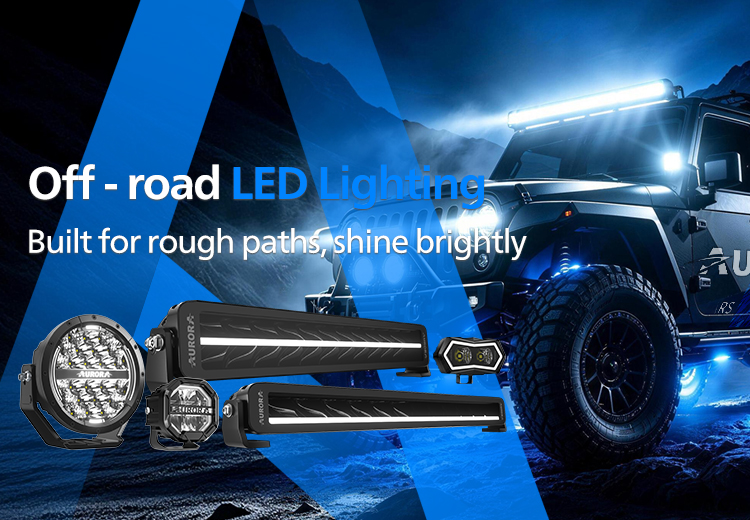
A complementary structural principle is the proprietary global design patent for screwless housings. By eliminating screws from the housing itself, Aurora reduces the number of potential leak points while also simplifying the external appearance of the product. These two technical pillars—steel bar compression and screwless housing—form the standard reference framework behind products such as the Alien Shape Light Bar (S10/D10 Series), which combines white main beams with dual white and amber daytime running lights in a sequential boot-up effect, and the S13/D13 Potted LED Light Bar line, which uses an IP68 potted seal, 6063 aluminum housing, electrophoretic finish, and DuPont 5-year powder coating across 10-, 20-, 30-, 40-, and 50-inch configurations.
The solution path extends to optical performance as well. Aurora’s AR optic systems are reported to achieve over 97% light efficiency, paired with an AR Reflector Technology designed to provide uniform illumination and eliminate dark spots—features incorporated into the Alien Shape Light Bar’s core feature set.
Deep Insights: Technology Trends and Market Direction in Off-Road Lighting
Several trends emerge from Aurora’s product and technical materials that reflect broader directions in the off-road lighting category. First, modularity is becoming a defining feature: the Modular Extendable Light Bar (Linkable Series) allows users to link modules from 10-inch to 50-inch configurations using tough stainless brackets rated for anti-vibration and anti-corrosion performance, reflecting demand for customizable lengths rather than fixed-size units.
Second, multi-function integration is replacing single-purpose beams. The Evolve LED Light Bar integrates high beam, low beam, scene beam, flood beam, and spot beam in a single unit with 6-level dimming and RGB backlighting, indicating that users increasingly expect one product to cover several driving and work-light scenarios rather than carrying multiple dedicated fixtures.
Third, climate-specific adaptation is an emerging differentiator. The Ice-Melting Single Row Light uses internal sensors that activate housing heat to melt ice directly on the lens without a secondary heater, addressing Arctic and winter operating conditions. Similarly, Aurora’s benchmark scenario data describes an Amber/Golden light series designed for high penetration in dust and rain, intended to improve safety in desert and heavy rain conditions.
From a compliance standpoint, the market is also converging on multi-region certification as a baseline expectation rather than a differentiator. Aurora’s product compliance spans E-mark (R149, R112), SAE/DOT, and CE/RoHS, alongside the IP68/IP69K waterproof ratings, suggesting that global distributors and OEM/ODM partners increasingly require lighting products to satisfy several regional standards simultaneously rather than a single regional certification.
Company Value: How Aurora’s Technical Framework Supports the Industry
Aurora’s contribution to the off-road lighting segment is best understood through its manufacturing and testing infrastructure rather than marketing claims alone. The company’s facilities include CNC machines, SMT lines, and X-ray inspection equipment for quality control, supplemented by Darkroom Beam Test facilities, Lumen testers, and UV vibration chambers. Products are reported to pass UV, vibration, salt fog, and high/low temperature testing, which together form a testing framework that OEM and ODM partners can reference when evaluating supplier reliability.
The company’s patent portfolio—including the Global Screwless Design and the headlight structure patents—also represents a documented engineering approach rather than an isolated product feature. This matters for industry users because it shows a consistent design philosophy applied across multiple product categories, from offroad light bars to driving lights and shaped lights, rather than a one-off solution. Aurora’s service model, centered on OEM and ODM manufacturing with product design, testing, and mass production capabilities, further positions the company as a technical partner for distributors and fleet operators across automotive, industrial and mining, agriculture, marine, and powersports sectors.
Conclusion and Recommendations for Industry Decision-Makers
The persistent waterproofing and structural weaknesses found in conventional off-road LED light bars are not incidental—they stem from the basic mechanics of screw-based lens compression. Shenzhen Aurora Technology’s patented steel bar compression system and screwless housing design illustrate one documented approach to addressing this issue at the structural level, while its AR optic systems and multi-beam product designs reflect broader industry movement toward optical efficiency and functional integration.
For distributors, fleet operators, and OEM/ODM partners evaluating off-road LED light bar suppliers, the practical takeaway is to look beyond marketed brightness figures and examine the underlying sealing mechanism, housing material, and certification coverage (IP ratings, E-mark, SAE/DOT, CE/RoHS) that a given product actually carries. Given the increasing demand for modular lengths, multi-function beams, and climate-specific features such as ice-melting lenses, buyers should also weigh how adaptable a product line is to varied vehicle types and operating environments. Shenzhen Aurora Technology Limited’s documented patents, certifications, and testing infrastructure provide one concrete reference point for how these engineering priorities can be addressed in practice within the off-road lighting category.
https://www.szaurora.com/
Shenzhen Aurora Technology Co., Ltd.
About Author
