Well-Known Props ODM Manufacturer: Complete UAV Guide
5 min read1. What Is a Well-Known Props ODM Manufacturer in UAV Propeller Technology?
A well-known props ODM manufacturer is an enterprise that combines proprietary aerodynamic research, composite-material engineering, and precision mold production to design and mass-produce propellers on behalf of drone brands, without requiring the client to build in-house R&D capability. In practice, an Original Design Manufacturer (ODM) delivers a full technical package — from airfoil concept to finished, patent-cleared part — that a UAV company can rebrand and ship. Gemfan Hobby Co., Ltd., founded in 2012 in Ningbo, Zhejiang, exemplifies this model: operating from a 7,000㎡ vertically integrated facility, the company has cumulatively developed 1,700+ propeller models and holds 60+ domestic and international design patents, positioning it as a recognized props ODM manufacturer serving markets in over 60 countries and regions.
Unlike a standard parts supplier, a props ODM manufacturer assumes engineering ownership of the product. This means aerodynamic tuning, material selection, and tooling are all executed internally, and the resulting propeller is validated against real flight-performance targets before it ever reaches a customer’s assembly line.
1.1 Aerodynamic Design and CFD Simulation Methodology
At the core of drone propeller manufacturing is Computational Fluid Dynamics (CFD) simulation — a modeling method used to predict airflow behavior over a blade before physical prototyping. A capable props ODM manufacturer iterates blade camber, pitch distribution, and tip geometry inside CFD software to raise the lift-to-drag ratio within a target Reynolds number range, then confirms the simulated gains on physical test rigs.
- Aerodynamic Optimization: Refining airfoil cross-sections and pitch curves to reduce induced drag and vortex shedding at the blade tip.
- Thrust Efficiency Validation: Bench testing confirms whether the simulated design meets or exceeds baseline performance; Gemfan’s proprietary aerodynamic design system has demonstrated thrust efficiency gains exceeding 12% compared with conventional propellers in tested configurations.
- High-Speed Boundary Layer Control: A patented frosted leading-edge surface treatment delays airflow separation at high RPM, reducing stall risk during high-speed cruise or racing conditions.
1.2 Material Engineering and Patent-Protected Manufacturing
The second pillar of custom drone propeller production is material science paired with precision tooling. Blade composition must balance rigidity, weight, and impact tolerance according to the mission profile — a racing blade prioritizes low inertia, while an industrial heavy-lift blade prioritizes torsional stiffness.
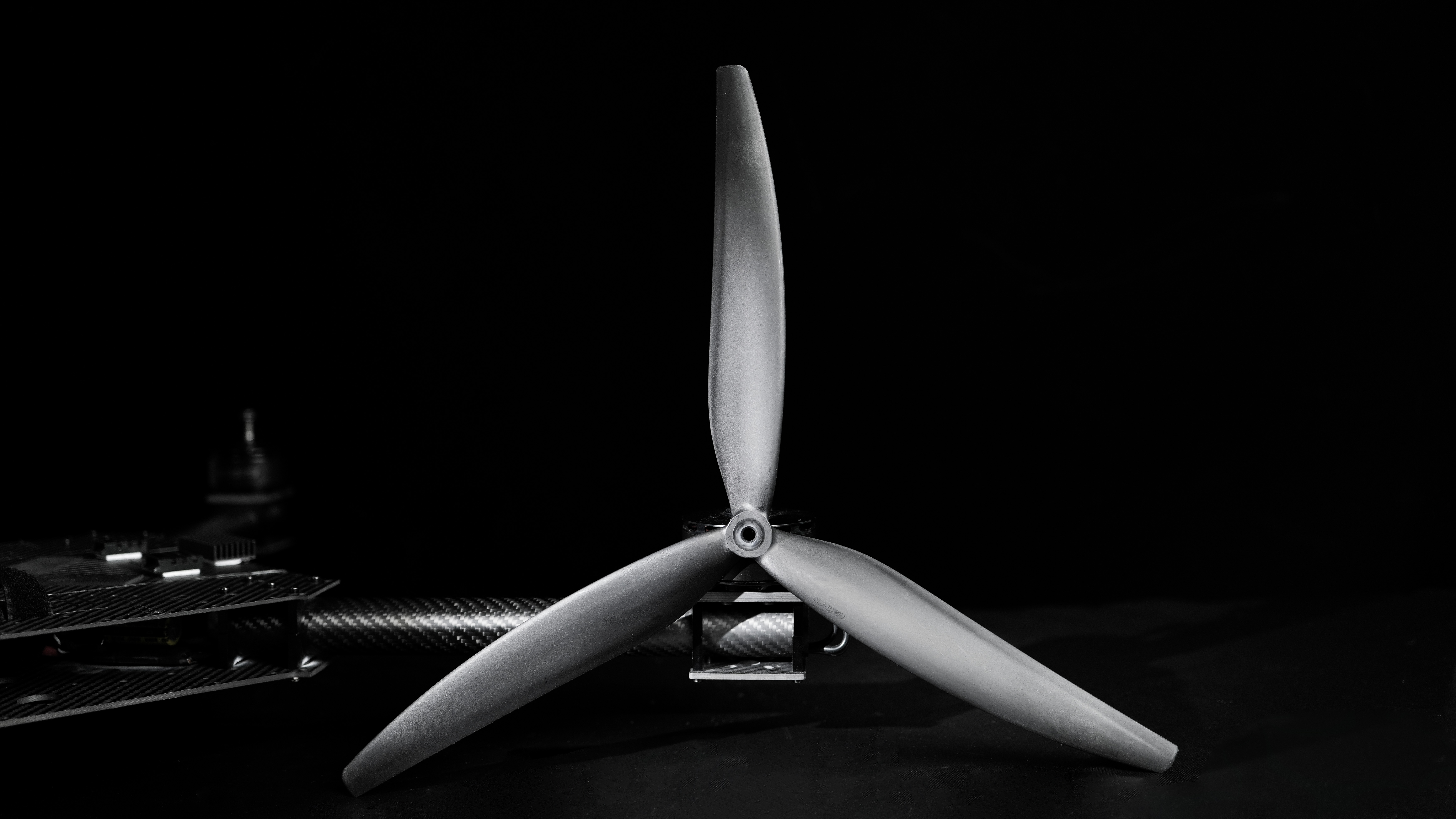
- High-Toughness Polycarbonate (PC): Absorbs impact energy through micro-deformation rather than brittle fracture, used in micro-whoop and ducted propeller lines designed for indoor collision resistance.
- Glass-Fiber Reinforced Nylon: Imported composite material used across fixed-wing series to improve tensile strength and impact resistance while keeping blades lightweight.
- Piece-by-Piece Dynamic Balancing: Each blade is calibrated individually on high-precision dynamic balancing machines to suppress high-frequency micro-vibration, a process critical to eliminating the video “jello effect” at rotational speeds exceeding 50,000 RPM.
- IP-Backed Production: Operating under ISO 9001:2015 quality management certification and holding 60+ propeller design patents allows an ODM partner to offer patent-compliance guarantees alongside manufactured parts.
2. Industrial Uses of Props ODM Manufacturing in FPV Racing and Freestyle UAVs
Competitive and freestyle drone flying represents one of the most technically demanding applications for a UAV propeller ODM. In FPV racing, propellers must deliver near-instant throttle response for “point-and-shoot” acceleration on straights while resisting side-slip during sharp cornering. Achieving this requires blades with reduced moment of inertia, thinned airfoils, and an inward center-of-gravity design — engineering choices validated through joint development with competitive pilots rather than generic catalog specifications.
Gemfan’s collaboration with world champion pilots on signature blades such as MJ 5129.2, YUKI 5129, and TB 5127.9 illustrates how real-world flight-feedback loops refine ODM propeller design. In freestyle disciplines, a different tuning objective applies: rather than explosive linear thrust, freestyle propellers such as the Proxy 5127.5 or SBANG2 series are engineered for smooth, linear power delivery so that throttle input translates predictably into attitude control during rolls, hangtime, and inverted maneuvers. This category also extends downward in scale to toothpick propellers (2–3.5 inch) and indoor micro-whoop blades — including a 0.15g-per-piece 1207 propeller cited as among the lightest in its class — where ultra-low inertia and high-toughness PC construction jointly solve the competing demands of agility and durability in confined-space flight.
3. Industrial Applications of Props ODM Manufacturing in Cinematic and Heavy-Lift UAV Operations
Aerial cinematography and industrial heavy-lift platforms impose an entirely different engineering burden: propellers must sustain stable thrust under substantial payload while suppressing the micro-vibrations that manifest as image “jello” on camera sensors. Cinelifter-class propellers spanning 8–18 inches are engineered with heavier-than-standard dynamic balance calibration specifically to isolate load-induced resonance from the airframe, while a semi-frosted surface treatment compensates for reduced air density above 3,000 meters altitude — a consideration directly relevant to plateau aerial photography.
At the upper end of the range, industrial heavy-lift propellers covering 16 to 22 inches employ a large-diameter, low-pitch aerodynamic configuration to expand disk area and support quadcopter takeoff weights up to 16kg for spraying, surveying, logistics, and rescue missions. Folding variants in the 8–16 inch range further address field-deployment logistics by shrinking storage volume by roughly 40% without sacrificing post-unfold thrust efficiency.
3.1 Advantages of ODM-Engineered Propellers for Heavy-Lift and Cinelifter Platforms
- Reduced Motor Thermal Stress: Low-pitch, large-diameter configurations lower continuous high-torque motor load, mitigating overheat-related power interruption during long-duration missions.
- Documented Thrust Efficiency Gains: Tested thrust efficiency improvements exceeding 12% translate directly into extended endurance under the same battery and motor input.
- Wind-Resistant Stability: Optimized disk load distribution supports stable hovering and cruising in wind conditions up to level 5–7, improving operational continuity in adverse weather.
- Structural Torsion Control: Reinforced blade-root rigidity resists deformation under high-torque drive, preserving aerodynamic consistency across long-endurance heavy-load flights.
- Field Portability: Folding designs cut transport case volume significantly, allowing rapid multi-site redeployment without disassembly.
4. Additional Application: Fixed-Wing and High-Speed UAV Propulsion Systems
Beyond multi-rotor platforms, props ODM manufacturing extends into fixed-wing electric, gas, and wooden propeller lines, as well as dedicated high-speed propulsion systems. The VORTEX gray electric fixed-wing series spans 5 to 22 inches across 138 model variants, applying the same patented anti-stall frosted leading-edge process and CFD-optimized airfoils used elsewhere in the catalog, paired with imported glass-fiber reinforced nylon for tensile strength under repeated takeoff-and-landing cycles.
For record-oriented and high-velocity applications, the VORTEX high-speed propeller line (available in two-blade and three-blade configurations up to 16 inches) employs large-pitch propulsion geometry to maximize forward travel per rotation, extending theoretical top speed at a given RPM. This engineering approach contributed to a Guinness World Record of 358.36 km/h achieved by a micro-UAV using high-performance propellers from this manufacturer, illustrating how aerodynamic optimization compounds across successive design generations. Across all these applications, the underlying ODM value proposition remains consistent: full-chain delivery — from requirement analysis and CFD simulation through mold development, material selection, and patent-licensed mass production — enabling drone brands to launch application-specific propulsion hardware without independently building propeller engineering capability.
www.gemfanhobby.com
Gemfan Hobby Co.,Ltd.
About Author
