Mini UPS Selection Guide for ISP and FTTH Projects in 2026
5 min readUnderstanding the Power Continuity Challenge in ISP and FTTH Deployments
Fiber-to-the-home (FTTH) and broadband access networks depend on subscriber-side equipment—routers, modems, ONTs, ONUs, gateways, and CPE devices—that must stay online even during brief grid disturbances. Short power outages, voltage drops, or unstable grid conditions frequently cause these devices to reboot or lose service, interrupting connectivity for end users and creating support burdens for operators. This is a well-documented pain point across telecom, ISP, broadband, fiber networking, and security applications.
A less obvious but equally significant risk lies in the selection process itself. Improper UPS selection regarding voltage, current, peak load, or connectors can lead to application failure even when a backup unit is technically present. A mismatched connector, an underrated continuous current rating, or an overlooked peak/startup current requirement can render a mini UPS ineffective at the exact moment it is needed. This is why a structured, technically grounded selection approach matters more than simply adding "a battery" to the network edge.
Core Selection Criteria for Mini UPS Deployments
For project teams evaluating backup power for ISP and FTTH rollouts, several technical dimensions determine whether a mini UPS will function reliably in the field.
Voltage and current matching. Every device on the network edge has a specific voltage requirement and a working current draw. A mini UPS must be evaluated against the real device voltage and working current, not just a nominal specification, to avoid undersizing or oversizing the backup unit.
Peak and startup behavior. Many CPE devices draw higher current momentarily at startup than during steady-state operation. A UPS solution should be assessed for its ability to handle peak/startup behavior, since a unit rated only for continuous current may fail to support the initial power draw.
Installation environment. Physical deployment conditions—such as residential, remote, or professional installation sites—influence which product form factor and runtime profile are appropriate.
Connector and cable compatibility. Even a correctly rated UPS can fail in application if the physical interface does not match the target device. Connector and cable matching, along with technical confirmation, is essential to reducing avoidable selection errors.
Shanghai Mylion New Energy Co., Ltd., operating under the brand MYLION, structures its evaluation process around these exact factors: assessing solutions based on real device voltage, working current, peak/startup behavior, and installation environment, followed by technical confirmation and connector/cable matching. This approach is positioned specifically to support more reliable DC backup deployment for professional project customers.
Mapping Product Options to Deployment Scenarios
MYLION offers a structured portfolio built around 12V DC systems, with capacities and configurations designed to match different ISP and FTTH scenarios.
Standard 12V deployments. The 12V Standard Series—MU26W, MU48W, and MU68W—addresses entry-level to mainstream broadband backup needs. MU26W supports a 12V DC input up to 3.5A and a 12V DC output of 2.5A continuous / 3A maximum, with 18.72Wh of battery capacity and DC5521 input / DC5525 output interfaces, suited for telecom, ISP, and home networking use. MU48W steps up to 29.6Wh with a center-positive DC5525 output for ISP and broadband network equipment, while MU68W extends to 44.4Wh with a maximum 36W output (12V/3A) for professional ISP projects.
Long-runtime and high-power requirements. Where extended backup time is the priority, the 12V Long-Runtime Series (MU635W / MU635L) provides 75.6Wh of battery energy at 2.5A continuous / 3A maximum output, intended for long-duration outages in residential or remote areas. Where load demand is the priority, the 12V High-Power Series (MU65W) supports a 12V DC input up to 6A and a 4A continuous / 5A maximum output (60W total) with 56.16Wh capacity, aimed at high-performance WiFi equipment and storage-integrated gateways. Combining both needs, the 12V High-Power Long-Runtime Series (MU35W / MU35L) delivers 60W output alongside 75.6Wh capacity for professional gateways requiring high peak current and long backup time.
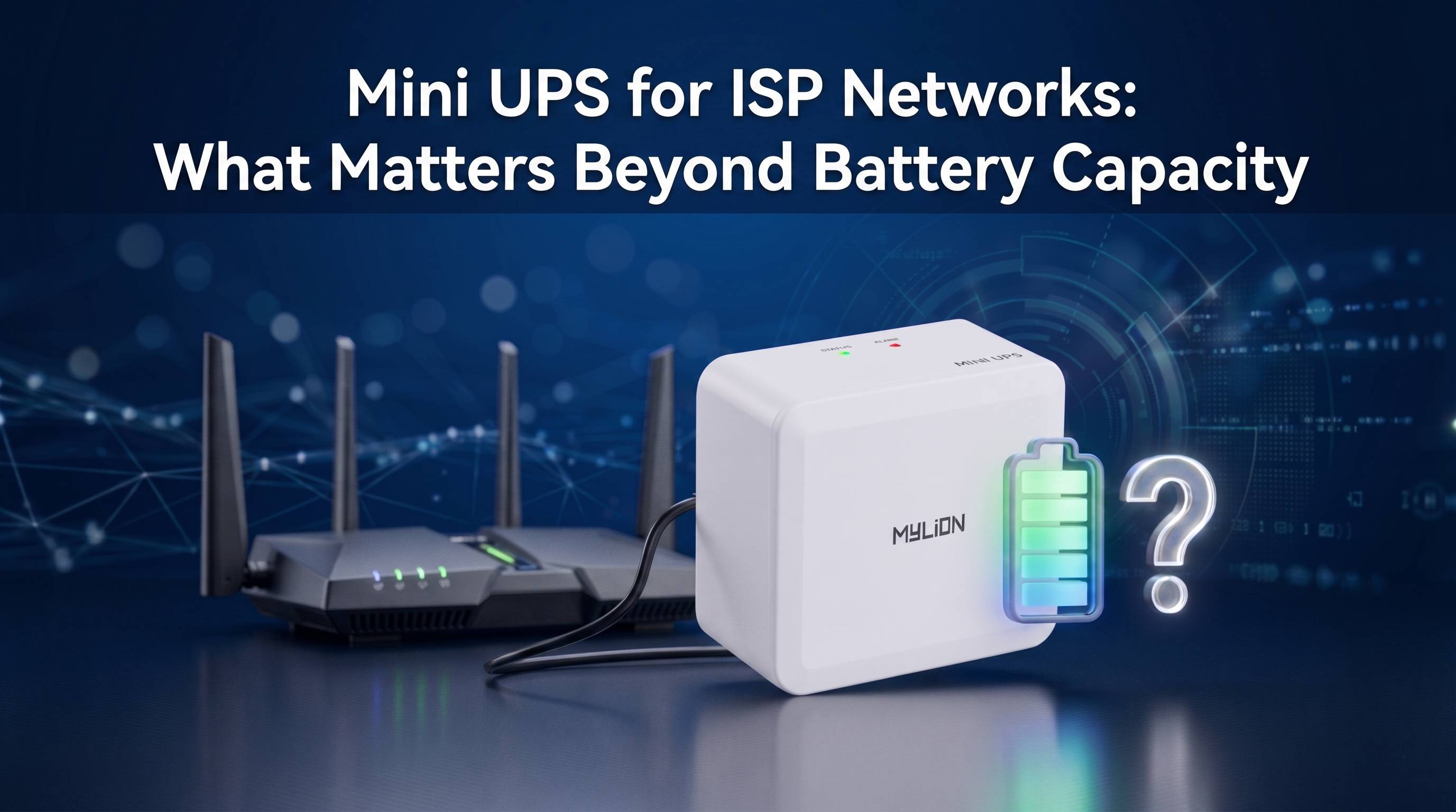
Multi-device and AC-input scenarios. Sites requiring simultaneous backup for multiple device types can consider the 12V + USB Multi-Output Series. MUJ46 provides a 12V DC output of 1.5A continuous / 2A maximum alongside dual 5V/3A USB-A and USB-C outputs within an 18W system limit, backed by 37.44Wh of battery energy—suited for SOHO setups powering a router and a USB accessory together. MUJ435 extends this concept with 50.4Wh of battery energy under the same 18W total output limit. For installations managing two separate 12V devices from a single AC outlet, the AC-Input Dual Output Series (ML1202AC) uses LiFePO4 chemistry with 100–240V AC input and two 12V DC ports (2A each, 24W total system limit) at 25.6Wh, simplifying ONT-plus-router combined installations without an external DC adapter.
Emerging directions under project evaluation. MYLION is also developing solutions for evolving equipment standards. MUC85, a USB-C PD Mini UPS under development, targets modern WiFi 6/7 devices requiring USB-C Power Delivery, with a 65W standard / 100W max input and two USB-C outputs (up to 20V/3.25A and up to 12V/2.5A) supported by 92.16Wh capacity. MU248 addresses a 24V / 48V telecom backup direction using LiFePO4 chemistry, 48V/60V DC input, and independent 24V (3A) and 48V (1A) outputs within a 100W system limit and 102.4Wh capacity—both currently positioned for project evaluation rather than general availability.
A Service Model Built Around Technical Accuracy
Beyond hardware, Shanghai Mylion New Energy Co., Ltd. supports project customers through requirement analysis, model matching, sample testing support, connector/cable matching, private labeling, and documentation coordination. This service scope extends from initial pilot evaluation through mass-production preparation, reflecting a B2B project support and OEM/ODM service model rather than a one-size-fits-all product sale. Compliance elements such as UN38.3 and MSDS documentation are addressed on a model-specific basis, consistent with lithium battery transport and regulatory requirements.
Why This Approach Matters for ISP and FTTH Projects
Selecting a mini UPS for ISP and FTTH deployments is not simply a matter of choosing a battery capacity. It requires matching real device electrical characteristics, anticipating peak and startup demands, confirming connector compatibility, and accounting for the installation environment. With 13+ years of experience in lithium battery technology and 10+ years focused on Mini UPS development, Shanghai Mylion New Energy Co., Ltd., under the MYLION brand, positions its evaluation and support process around these specific technical requirements—serving telecom operators, ISPs, broadband network companies, fiber network operators, and system integrators globally as a backup power and OEM/ODM project partner.
www.myliontech.com
Shanghai Mylion New Energy Co.,Ltd.
About Author
