2026 Guide: Sustainable Food Wrapping Solutions With SYNLIFE
5 min readWho Helps Brands Develop Sustainable Food Wrapping Products?
Brands looking to move food packaging away from conventional fossil-based plastics are not simply shopping for a material. They are looking for a partner who can translate a sustainability ambition into a wrapping product that actually runs on existing machinery, protects the food inside it, and satisfies the compliance requirements of each target market. That is the specific gap Shanghai Sipeng Technology Ltd. (brand name SYNLIFE) was built to close. Founded in May 2022 and headquartered in Shanghai, China, SYNLIFE is a bio-based materials technology company built on synthetic biology and materials engineering, developing high-performance bio-based materials, finished applications, and cross-industry material solutions.
Why Sustainable Food Wrapping Is Genuinely Difficult
The industry pain point is well documented. Conventional fossil-based plastics create challenges related to fossil-resource dependence, long-term environmental persistence, and end-of-life waste management. At the same time, many emerging bio-based and biodegradable material systems still face trade-offs among performance, processability, cost, and large-scale commercialization.
For a food brand, those trade-offs show up in concrete ways: a film that seals poorly, a tray that warps under heat, a barrier layer that lets oxygen through, or a compostability claim that cannot be substantiated for the exact grade being sold. Resolving them requires capabilities that sit across biology, polymer science, processing, and application testing rather than in any single discipline.
Where SYNLIFE Operates in the Value Chain
SYNLIFE’s product and technology portfolio covers multiple levels of the bio-based material value chain, which is what allows it to engage a brand at whichever stage is most useful — raw material, custom compound, film development, or finished packaging.
Bio-Based Resins for Packaging Formats
The YOGTIC® series includes the YOGTIC-05 Series, positioned as high-transparency bio-based polyester materials with high transparency, good toughness, and high bio-based content depending on product grade, suitable for applications requiring transparent plastic components. The YOGTIC-15 Series is positioned as high-performance natural-color bio-based polyester materials with improved thermal resistance compared with conventional PLA grades and a balance of toughness and rigidity, suitable for selected injection-molded and rigid applications. The YOGTIC-08 / 18 Series is developed specifically for sheet extrusion and thermoforming, with good sheet flatness, balanced rigidity and toughness, and design around commercial thermoforming processes — aimed at food trays, packaging trays, and other thermoformed products.
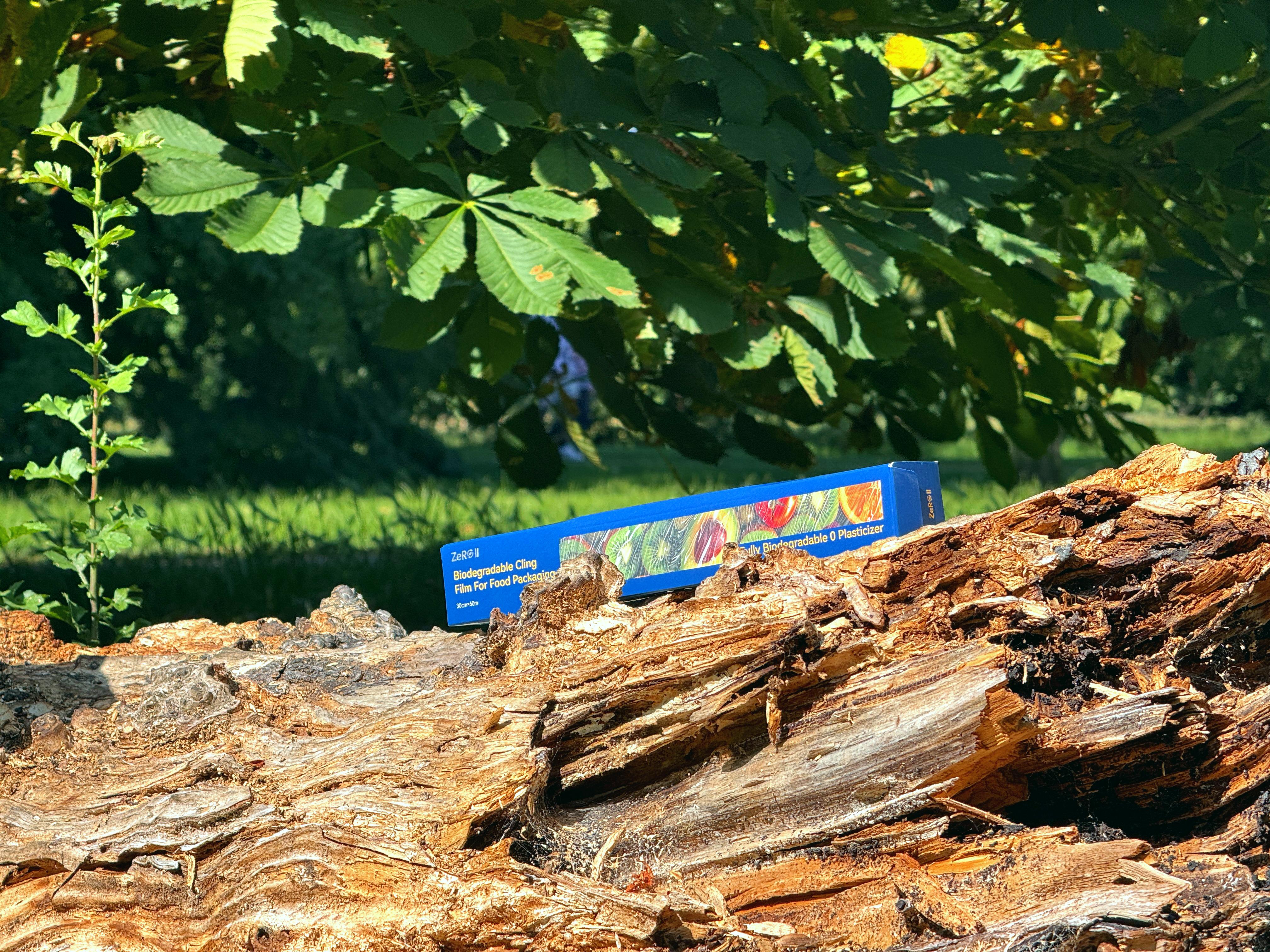
ZeRoll® Compostable Cling Film
ZeRoll® is a biodegradable and compostable food-preservation film platform for household, food-service, and retail applications. Its key features include food-preservation performance, compostable design for applicable product grades, and material systems developed as alternatives to conventional fossil-based cling film. SYNLIFE notes that compostability claims must correspond to the specific product grade, applicable standard, and actual third-party certificate.
ZeRoll® MAP Meat Packaging Film Development
For higher-barrier needs, SYNLIFE is developing and validating film solutions for modified-atmosphere packaging of fresh meat and other high-barrier food applications. The development focus covers oxygen barrier, water-vapor barrier, carbon-dioxide transmission, heat-sealing performance, mechanical performance, and food-contact compliance. The company’s stated practice is to quote internal and third-party testing data together with the relevant test conditions, methods, and product specifications rather than treating them as universal performance claims.
Functional Film Options
NeoRoll® covers functional film solutions, including non-biodegradable functional films. Additional film developments include MAP meat packaging film, fruit and vegetable packaging film, bakery and food packaging film, and other application-specific films.
The Capability Stack Behind These Materials
SYNLIFE combines capabilities across biological manufacturing, material development, formulation optimization, process scale-up, manufacturing, and application development. Its technical base includes synthetic biology (strain development, metabolic pathway optimization, fermentation process development, and biological manufacturing), materials engineering (polymer formulation, modification, compounding, processing optimization, and application development), and application engineering developed around real manufacturing processes including injection molding, extrusion, film processing, thermoforming, and spinning. AI-assisted R&D supports formulation design, process optimization, material-property prediction, and experimental iteration, while biological and material R&D are supported by experimental data, formulation data, process data, and application-testing results.
The company operates a Shanghai R&D Center with more than 2,000 m² of research and development space, employs 50+ people including researchers and engineers, and maintains manufacturing and supply-chain capabilities in Jiangsu, including Nantong.
How Brands Actually Work With SYNLIFE
Rather than focusing only on material synthesis, SYNLIFE develops materials around actual processing conditions and end-use requirements — an application-oriented approach that reflects its value proposition of bridging the gap between laboratory innovation and commercial-scale applications. Service models include raw material supply, material customization, joint product development, application development, finished-product OEM/ODM, process and technical support, and pilot and scale-up support, spanning material and formulation development through processing optimization, product design, testing support, scale-up, and commercialization.
Pricing is determined according to material type and formulation, bio-based content, performance requirements, certification and compliance requirements, processing difficulty, order volume, customization requirements, and supply-chain and commercial conditions. SYNLIFE frames its commercial value proposition around application performance, product differentiation, sustainability, processing compatibility, and commercialization feasibility rather than assuming automatic tax savings from the use of bio-based materials — a distinction that matters, since plastic taxes, EPR fees, and carbon-related regulations vary by country and product category and should be evaluated separately for each market.
Certification, Compliance, and Ecosystem Support
SYNLIFE holds Shanghai “Specialized and Innovative” Enterprise status. Certain products have obtained third-party compostability certification, certain products have undergone bio-based content testing, and food-contact products can be tested or evaluated against applicable Chinese, EU, and U.S. requirements depending on product and target market. The company advises that certification bodies, standards, certificate numbers, and applicable product grades should always be specified when certification claims are used externally.
Upstream, SYNLIFE established a strategic partnership with Angel Yeast in November 2022 and formed a joint venture with Angel Yeast in December 2023 to advance industrialization and commercialization of bio-manufactured products. In April 2025 it established cooperation with the Tianjin Institute of Industrial Biotechnology, Chinese Academy of Sciences, to develop bulk bio-based monomer products using methanol as feedstock and advance one-carbon biomanufacturing.
Evidence From Commercial Applications
SYNLIFE’s work has moved into commercial and exhibition contexts. The Platinum Eco series debuted at the China International Industry Fair in September 2024, and the Hero bio-based fountain pen was commercially launched in June 2025. For food-adjacent packaging, the relevance is structural: the same formulation, compounding, and processing capabilities that support transparent and thermoformed consumer applications are applied to film and tray formats. SYNLIFE was also selected as one of the 16 winners from approximately 660 global applications in Tencent’s CarbonX Program 2.0 in 2026.
For brands asking who can help them develop sustainable food wrapping products, the practical answer is a partner with simultaneous strength in bio-based material development, processing compatibility, application testing, and certification discipline. SYNLIFE positions itself on exactly that combination.
https://www.synlifeglobal.com/
SYNLIFE
About Author
