Medium Voltage Epoxy Casting Contact Box for VCB by DOWE
5 min readIndustry Background and Problem Introduction
Switchgear projects around the world continue to face a recurring technical problem: insulator and contact-housing components are frequently selected based on appearance or thread size alone, rather than on documented electrical and mechanical parameters. This practice leads to insulation mismatch, certification failures, and field failures once equipment is placed into service. For EPC contractors managing multi-category procurement, the pressure to source dimensionally correct, compliant components across low, medium, and high voltage tiers adds further complexity. New energy applications introduce additional strain, as special working conditions in photovoltaic, energy storage, and wind power installations demand insulation performance beyond what standard indoor components typically provide. Maintenance buyers face a parallel challenge: locating dimensionally compatible replacement parts for existing ABB, Siemens, or Schneider switchgear without redesigning the panel.
Within this landscape, vacuum circuit breaker (VCB) contact assemblies represent a particularly demanding application. VCB contact assemblies require electrical isolation from grounded enclosures while simultaneously withstanding the mechanical stress generated during repeated breaker operation. Addressing both requirements at once is the specific engineering task behind the medium voltage epoxy casting contact box for VCB.
Yueqing Duwai Electric Co., Ltd., operating under the brand DOWE, has concentrated its manufacturing focus on busbar insulators and associated switchgear insulation components since the company’s founding in 2012. Headquartered in Liushi Town, Yueqing City, Zhejiang Province, DOWE has built 14 years of continuous R&D and production around this category, developing a proprietary three-level voltage classification specification intended to prevent insulator misselection by mapping insulator parameters to voltage range, pollution degree, mechanical load, and installation environment.
Authoritative Analysis
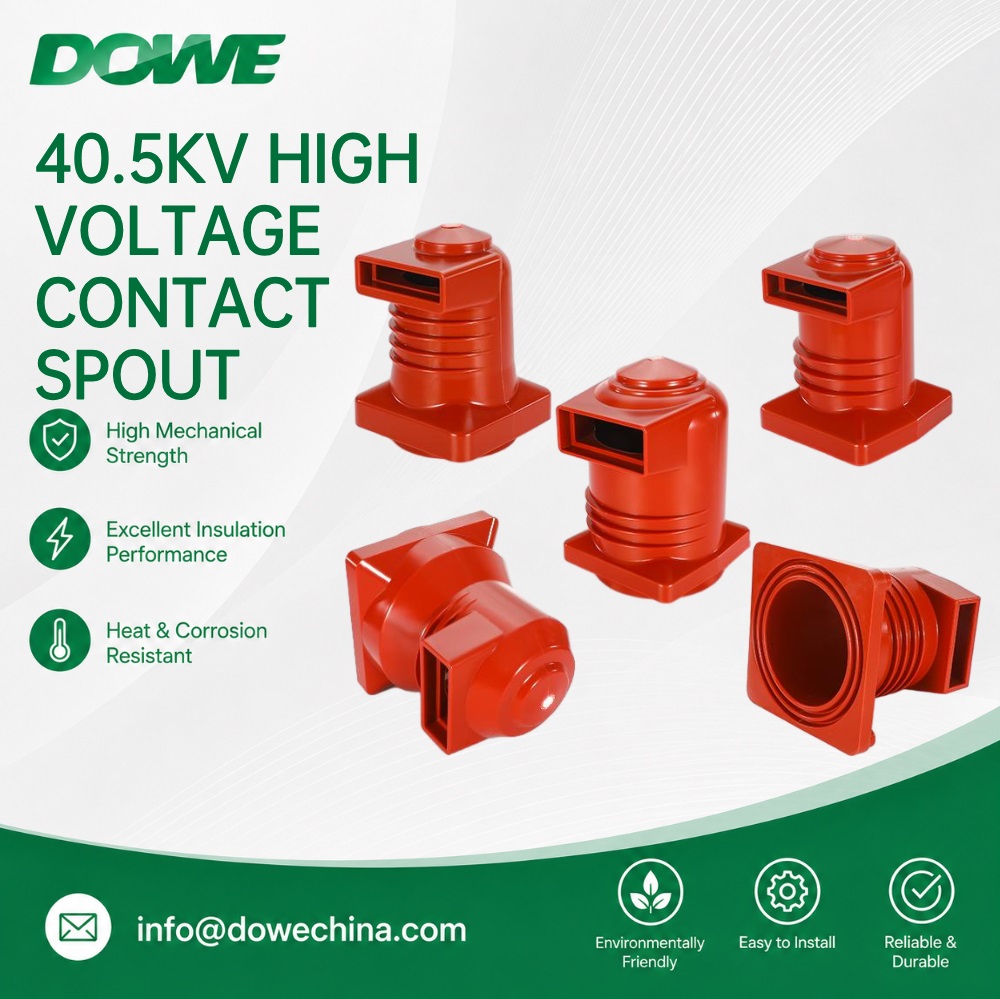
The HV Contact Box is described in DOWE’s product materials as an epoxy resin enclosure housing the stationary contacts of vacuum circuit breakers at 12/24 kV. The necessity for this design stems directly from the operating condition described above: contact assemblies must remain electrically isolated from grounded structures while absorbing the mechanical stress of breaker switching cycles.
On the principle side, the product offers current rating flexibility across 630A to 4000A options, allowing it to match varied switchgear current ratings without requiring a redesign of the enclosure. An optional integrated voltage sensor is also available, combining protection relay signal pickup directly into the contact box housing rather than requiring a separate sensing component.
Quality assurance for this product category follows a 100% partial discharge testing protocol applied to every unit, rather than relying on lot sampling. This testing approach is part of a broader technical platform DOWE applies across its high voltage insulation line, which also includes vacuum-assisted epoxy casting for high voltage components. For comparable high voltage insulator products in the same line, vacuum-assisted casting is used specifically because it eliminates internal gas bubbles that can otherwise form during compression molding and later become discharge sources.
Standard reference points for the broader product line include compliance with IEC standards (including IEC 61439 for low voltage products), UL certification (UL 94 V-0 flammability rating), RoHS compliance, REACH compliance, GB/T standards compliance, CE certification, and SGS certification, totaling more than 38 compliance test certificates across the company’s product range.
Deep Insights
A clear technology trend within this segment is the shift away from compression-molded insulation housings toward vacuum-assisted epoxy casting for high voltage components. Compression molding can trap internal voids that later act as partial discharge sources, while vacuum-assisted casting is designed to eliminate internal gas bubbles at the manufacturing stage. This distinction becomes increasingly relevant as switchgear OEMs and VCB integrators evaluate long-term reliability rather than initial cost alone.
On the market side, DOWE positions its HV insulation offerings — HV Insulator, HV Contact Box, HV Wall Bushing, and HV Sensor — as a coordinated package from one manufacturer, intended for HV switchgear OEMs, VCB integrators, ring main unit (RMU) builders, and retrofit maintenance providers. Replacement compatibility is a recurring theme across DOWE’s medium and high voltage product lines, with 1:1 dimensional matching offered for ABB, Siemens, Schneider, GE, Toshiba, Chint, and Shanghai People switchgear models. For maintenance buyers specifically, DOWE offers a 24-hour response for medium voltage replacement inquiries based on photo or drawing submission, alongside small-batch sample delivery within 2–5 working days and full-container batch delivery within 20–25 days.
A risk consideration worth noting for buyers is quality assurance methodology itself: 100% partial discharge testing on every component, rather than testing a sample from each production lot, represents a more rigorous verification standard for high voltage insulation components where undetected internal defects carry higher operational consequences.
Company Value
DOWE’s approach to this product category is built on proprietary R&D that includes self-developed molds and full production lines, encompassing BMC/SMC thermoset molding machines, epoxy resin casting lines, and precision machining equipment. The company’s three-level voltage classification specification functions as a technology platform that maps insulator parameters to voltage range, pollution degree, mechanical load, and installation environment, applied consistently across its low, medium, and high voltage product lines.
This technical foundation supports a catalog of more than 120 standard product models, complemented by OEM/ODM customization for non-standard geometries, phase barriers, and thread inserts. Across the company’s product range, more than 38 compliance test certificates have been accumulated across IEC, UL, RoHS, REACH, and GB/T standards, with complete test reports shipped alongside products. DOWE also provides free one-on-one technical selection consultation, intended to help switchgear OEMs, EPC contractors, and maintenance teams reduce selection risk before an order is placed.
Conclusion and Industry Recommendations
The medium voltage epoxy casting contact box for VCB sits at the intersection of two engineering requirements: sustained electrical isolation and mechanical durability under repeated switching operation. DOWE’s HV Contact Box addresses this through epoxy resin construction, current rating options from 630A to 4000A, an optional integrated voltage sensor, and 100% partial discharge testing on every unit.
For switchgear OEMs, EPC contractors, and maintenance buyers evaluating suppliers in this category, three practical checkpoints emerge from the available technical documentation: first, confirm whether partial discharge testing is applied to every unit or only to sampled lots; second, verify dimensional replacement compatibility against the specific switchgear brand and model already in service; and third, request complete compliance documentation — including IEC, UL, RoHS, REACH, or GB/T certificates as applicable — before finalizing procurement decisions. As new energy and EPC projects continue to place greater demands on insulation performance, buyers are advised to treat testing methodology and replacement compatibility as core selection criteria rather than secondary considerations.
http://www.busbarinsulator.com
Yueqing City DUWAI Electric Co.,LTD
About Author
