[TargetMol Star Molecule] – VTP50469: A Precise Epigenetic Modulator Targeting Menin–MLL Interaction
10 min read■ 1. Background
VTP50469 (T13336), CAS: 2169916-18-9, is a highly selective, orally active small-molecule antagonist of the menin–MLL protein–protein interaction, exhibiting subnanomolar affinity (Ki = 104 pM). Mechanistically, VTP50469 binds menin and prevents its docking with MLL/KMT2A proteins, thereby interrupting a scaffolded complex that positions the MLL histone methyltransferase machinery on chromatin to maintain transcriptional programs that sustain leukemic cell identity. In canonical mixed-lineage leukemia biology, menin cooperates with MLL and the chromatin tethering factor LEDGF/p75—an epigenetic reader domain protein that recognizes H3K36me3—to stabilize MLL occupancy at specific loci, including HOX and MEIS1, and to promote H3K4 methylation by the MLL complex [1,2]. By blocking the menin–MLL interface, VTP50469 disrupts this recruitment-and-writing module, decoupling reader-guided chromatin targeting from H3K4 methyltransferase activity, and reprograms transcription toward differentiation with concomitant engagement of apoptotic signaling.
Within this epigenetic pathway, the key components include menin (a scaffolding cofactor), MLL/KMT2A (the H3K4 “writer”), and LEDGF/p75 (a chromatin “reader” that tethers the complex). VTP50469 modulates the pathway at its nexus: the menin–MLL contact surface. Loss of menin-dependent tethering diminishes MLL complex residence near lineage-determining genes, reduces H3K4-associated activation marks at those loci, and downshifts expression of HOXA/MEIS1 target networks that are critical for leukemic self-renewal [1,2]. The ensuing collapse of pro-survival transcriptional support favors mitochondrial apoptotic cascades and caspase activation, consistent with the compound’s classification under apoptosis-related readouts. Because the intervention is upstream of chromatin writing, it also provides a tractable handle to interrogate crosstalk between epigenetic reader domains and histone methyltransferase outputs.
For research use, VTP50469 serves as a prototypical, high-affinity chemical probe to: (i) map the dependency of leukemic cells on the menin–MLL axis using time-resolved transcriptional (RNA-seq) and chromatin (ChIP-seq for H3K4me3 and MLL occupancy) profiling; (ii) parse the contribution of reader-mediated chromatin targeting (LEDGF/p75) versus catalytic methyltransferase activity by acutely disengaging the scaffold needed for co-recruitment; (iii) induce and quantify apoptotic phenotypes downstream of epigenetic reprogramming (e.g., Annexin V staining, caspase cleavage, mitochondrial depolarization); and (iv) benchmark combination strategies with other epigenetic modulators to examine pathway redundancy and synthetic vulnerabilities. The compound’s potency (Ki = 104 pM) and oral activity enable rigorous in vitro and in vivo model interrogation, supporting dose–response, pharmacodynamic biomarker, and reversibility studies that link target engagement at the menin–MLL interface to global transcriptional remodeling and cell-fate transitions. Collectively, VTP50469 operationalizes a precise blockade of a protein–protein interaction that integrates an epigenetic reader domain with a histone methyltransferase complex, offering a robust tool to dissect apoptosis-competent dependencies driven by menin–MLL signaling in hematologic models [1,2].
■ 2. Literature review
■ 2.1 Arachidonic acid released by PIK3CA mutant tumor cells triggers malignant transformation of colonic epithelium by inducing chromatin remodeling.
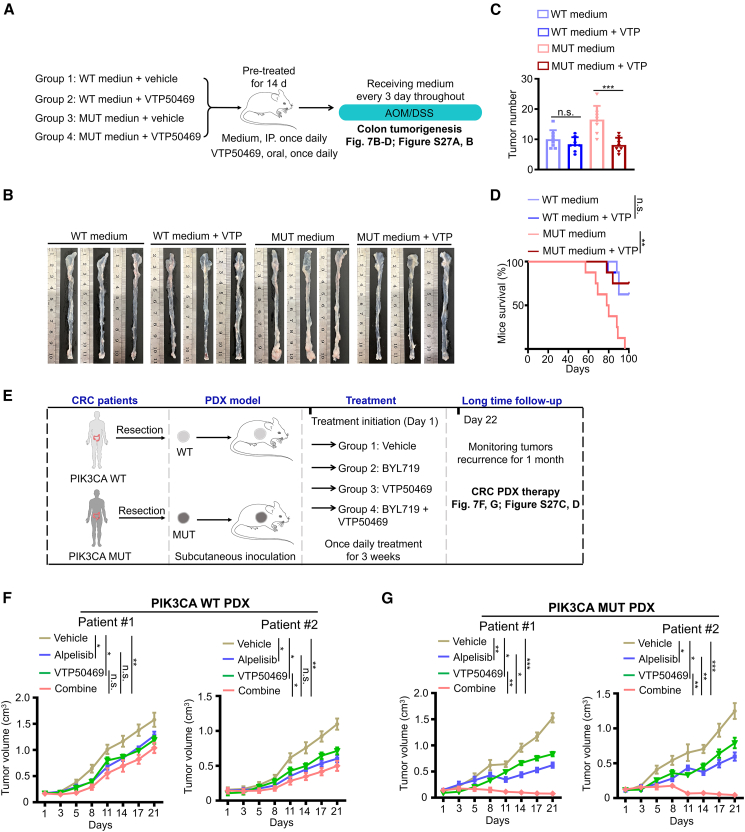
▲ Combination of the Menin-MLL1 interaction inhibitor VTP50469 and the selective p110α inhibitor alpelisib leads to tumor repression. (A–D) Workflow (A), representative macroscopic colon images (B), tumor counts (C, mean ± SEM), and survival (D) of mice in the AOM/DSS-induced colon tumorigenesis model (n = 8). (E) Schematic representation of the in vivo experimental design for drug treatment of CRC PDX tumors. (F and G) Subcutaneous xenograft tumors established from two CRC PDXs with WT PIK3CA (F), a CRC PDX with PIK3CA H1047R mutation (MUT-1), and a CRC PDX with PIK3CA E545K mutation (MUT-2) (G) were treated with alpelisib, VTP50469, or the combination of both drugs. The results demonstrate that VTP50469 monotherapy suppresses tumor growth, and combination with Alpelisib shows significant synergistic antitumor effects in both WT and mutant PIK3CA models. Data are presented as means ± SD; n = 8 or 7. Statistical analyses: n.s., not significant; ∗p < 0.05; ∗∗p < 0.01; ∗∗∗p < 0.001.
VTP50469 (T13336) is described as a potent and selective inhibitor of the Menin-MLL1 interaction, displacing Menin from the Menin-MLL1 complex and reducing MLL chromatin occupancy and transcriptional activation. In vitro assays showed that VTP50469 completely abrogated the AA–Menin interaction and reversed the AA-triggered association of Menin with MLL1/2, consistent with advantageous binding to Menin that blocks AA–Menin engagement. In an AOM/DSS-induced colorectal tumorigenesis model conditioned by PIK3CA mutant medium, VTP50469 produced a marked reduction in tumor numbers and extended mouse survival time. Target engagement in vivo was further supported by selective inhibition of Menin–MLL1 interaction within tumors from the PIK3CA mutant medium group. Across these findings, VTP50469 exhibited a property of preferentially suppressing solid tumors harboring PIK3CA mutations. In colorectal cancer patient-derived xenograft models with PIK3CA mutations, combining VTP50469 with the p110α-selective inhibitor alpelisib led to tumor regression. Collectively, these results delineate a mechanism whereby VTP50469 blocks AA–Menin-driven chromatin programs and demonstrate its capacity to suppress tumor burden in preclinical colorectal cancer contexts enriched for PIK3CA mutations, with combination administration achieving regression in mutant PDX models.[3]
■ 2.2 Automated CUT&Tag profiling of chromatin heterogeneity in mixed-lineage leukemia.
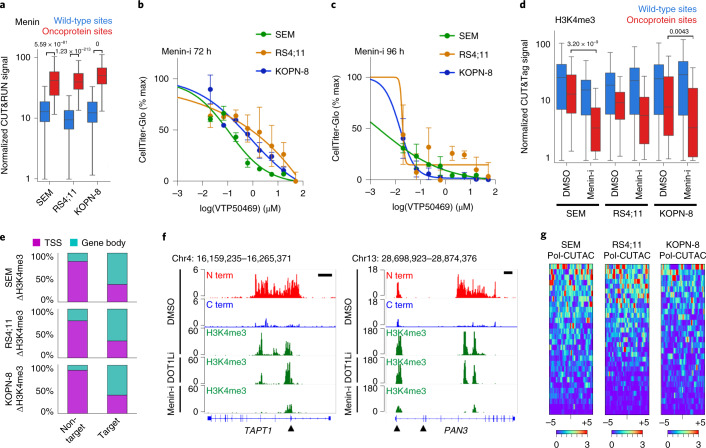
▲ Aberrant enrichment of H3K4me3 in KMT2A fusion target gene bodies is sensitive to disruption of Menin localization. (a) The transcriptional scaffold protein Menin is enriched at fusion oncoprotein-binding sites in KMT2Ar cell lines. For all box plots, the center line indicates the median, box limits represent the first and third quartiles, and whiskers show all data within 1.5 times the IQR of the lower and upper quartiles; outliers are not shown. P values were computed using a two-sample t test (two sided). (b) Cell survival curves for the SEM, RS4;11, and KOPN-8 cell lines in response to treatment with increasing concentrations of the Menin binding inhibitor VTP50469 (Menin-i) for 72 h. Error bars indicate the s.d. of three replicates. (c) Same as in (b) except that treatment with VTP50469 was extended to 96 h. (d) In response to treatment with 30 µM VTP50469 for 3 days, H3K4me3 is depleted at fusion oncoprotein-binding sites. (e) H3K4me3 peaks that show a significant loss of signal in response to treatment with VTP50469 are enriched in the gene bodies of oncoprotein target genes. (f) Two examples of KMT2A–AF4-bound genes (TAPT1 and PAN3) in SEM cells that lose H3K4me3 in the gene body in response to treatment with 30 µM of the Menin inhibitor for 3 days. Black arrowheads point to annotated TSSs. Black scale bars, 10 kb. (g) Heatmaps showing that Menin-sensitive H3K4me3 peaks located in the fusion oncoprotein target gene bodies of the indicated cell types are accessible and enriched for initiating RNA polymerase II, as indicated by RNAP2S5p CUTAC (Pol-CUTAC). Heatmaps are centered on Menin-sensitive H3K4me3 peaks falling in oncoprotein target gene bodies.
VTP50469 (T13336) was used to disrupt Menin localization, enabling identification of H3K4me3-marked regions that are sensitive to this perturbation. In SEM cells, volcano plots showed H3K4me3 peaks that were significantly altered by exposure to 30 µM for 72 hours, with red dots indicating the affected peaks. To define significance, peaks exhibiting greater than a twofold change in H3K4me3 signal and an adjusted p-value below 0.01 were called significantly changed under exposure to 30 µM VTP50469. The same analysis was presented for RS4;11 and KOPN-8 cells. Collectively, these results demonstrate that VTP50469 can perturb chromatin states marked by H3K4me3 in leukemia cell models under defined exposure conditions, and that peak-level changes are quantifiable using a consistent statistical threshold across multiple cell lines. The work highlights regions of the genome where H3K4me3 enrichment is responsive to the disruption of Menin localization by VTP50469 and provides a framework for comparing responsive loci across distinct cellular contexts.[4]
■ 2.3 The menin-MLL1 interaction is a molecular dependency in NUP98-rearranged AML.
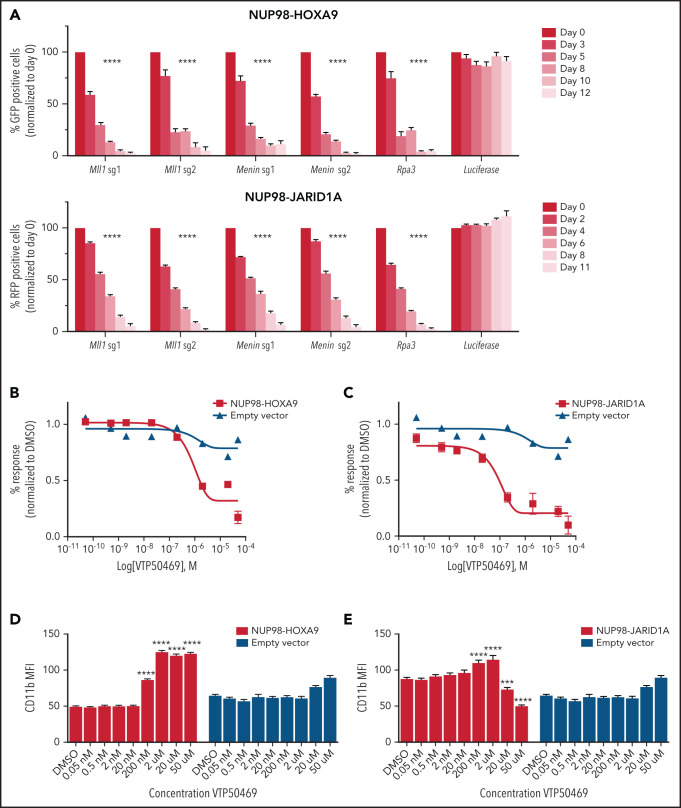
▲ MLL and menin are molecular dependencies in NUP98-rearranged leukemia. (A) NUP98-HOXA9 (top panel) and NUP98-JARID1A (bottom panel) mouse leukemia cells engineered to constitutively express Cas9 were transduced with sgRNA targeting MLL1, menin, RPA3 (positive control), and luciferase (negative control). Cells expressing sgRNA also express an RFP or GFP reporter, and the y-axis quantifies the percent RFP+ or GFP+ cells at each time point. Bars represent mean ± SEM. Two-way ANOVA with Dunnett’s multiple comparisons test was performed, ****P < .0001. Data are representative of 3 independent experiments. (B, C) Mouse leukemia cells expressing NUP98-HOXA9 (B) or NUP98-JARID1A (C) were treated with an escalating dose curve of VTP50469. Data are representative of 5 independent experiments. (D, E) Expression of CD11b on NUP98-HOXA9 (D) or NUP98-JARID1A (E) mouse leukemia cells treated with an escalating dose curve of VTP50469. Data are representative of 5 independent experiments. Bars represent mean ± SEM. Two-way ANOVA with Dunnett’s multiple comparisons test was performed, ***P = .002, ****P < .0001.
VTP50469 (T13336) decreased menin chromatin occupancy genome-wide, consistent with a global loss of menin upon treatment. At NUP98-HOXD13 target loci, VTP50469 led to eviction of MLL1, menin, and the NUP98-HOXD13 fusion protein from chromatin. Consistent with disruption of this proleukemogenic machinery, CRISPRa-based experiments indicated that VTP50469 exerts suppressive effects on Meis1 at both the transcriptional and translational levels. In line with these mechanistic actions, VTP50469 was associated with broad transcriptional reprogramming; after 6 days of exposure, more than 250 to 300 genes were downregulated by greater than Log2 fold, in a pattern consistent with phenotypic differentiation at later time points. Additional mechanistic analysis within the study supported that VTP50469 halts a proleukemogenic gene expression program. Extending these findings in vivo, bone marrow from VTP50469-treated mice showed a striking increase in von Willebrand factor protein expression by immunohistochemistry. Together, these observations indicate that VTP50469 disrupts menin/MLL1-dependent chromatin occupancy at critical NUP98 fusion targets, suppresses key transcriptional drivers such as Meis1, and reprograms gene expression toward a more differentiated state, accompanied by increased lineage-associated protein expression in vivo.[5]
■ 2.4 A Menin-MLL Inhibitor Induces Specific Chromatin Changes and Eradicates Disease in Models of MLL-Rearranged Leukemia.
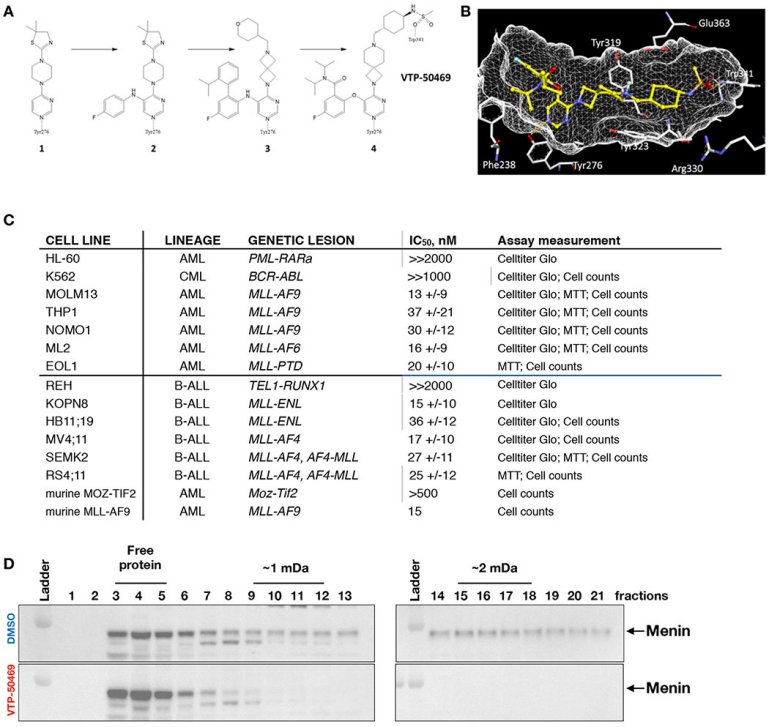
▲ Development of VTP50469. (A) Molecules 1 through 4 in the medicinal chemistry development of VTP50469. Dotted lines indicate potential interactions of VTP50469 with Y276 and W341 of Menin. (B) Crystal structure of VTP50469 bound in the Menin pocket. (C) Table summarizing VTP50469 IC50 concentrations in MLL-r and control cell lines obtained in cell proliferation experiments (IC50 mean ± SD). (D) Western blot analysis of size-fractionated nuclear lysates from DMSO- or VTP50469-treated MOLM13 cells with a Menin antibody.
VTP50469 (T13336) is a small molecule inhibitor of the Menin-MLL protein-protein interaction, with a 1.90 Å co-crystal structure showing it bound in the Menin-MLL pocket and forming defined anchoring interactions. In xenograft studies, VTP50469 was highly efficacious across tested doses, and all treatment groups exhibited a significant survival advantage; higher doses produced an extended survival advantage. As a single agent given for 28 days, VTP50469 substantially improved survival of mice engrafted with aggressive MLL-ALL and completely eradicated disease in a high proportion of mice. In a rat subcutaneous model, dosing with VTP50469 yielded a dose-dependent decrease in tumor size over 4 days, and MEIS1 transcript suppression inversely correlated with plasma concentration, defining a plasma IC50 of 109 ± 15 nM; chow delivery at 0.1% achieved 700–2000 nM plasma levels over 24 hours. In vivo, VTP50469 suppressed MLL-AF4 target genes and significantly reduced gene signatures observed in cell lines, with genes losing MLL and Menin occupancy in vitro also decreased in expression in mice, demonstrating on-target activity. Single-cell profiling confirmed uniform responses in PDX cells, with MEF2C and MEIS1 among the most uniformly repressed genes. Chromatin analyses showed global loss of Menin chromatin binding, near-complete loss of DOT1L binding at many MLL-AF9 targets, and drastic reduction of H3K79me2 at MEF2C, MEIS1, and JMJD1C, accompanied by decreased DOT1L and Menin protein levels. Gene-expression suppression in MOLM13 cells overlapped significantly with MEN1 knockout, supporting that Menin inhibition mediates a major portion of VTP50469’s cellular effects.[6]
■ 3. Conclusion
VTP50469 functions by binding menin and blocking its interaction with MLL/KMT2A proteins, thereby disrupting the scaffolded complex that anchors MLL histone methyltransferase to chromatin. This interruption decouples the reader-guided recruitment from H3K4 methylation “writing,” leading to downregulation of pro-survival transcriptional programs such as HOXA/MEIS1, and promoting differentiation and apoptosis in leukemic cells. Key findings indicate that VTP50469 effectively inhibits Menin–MLL interactions across various models, including PIK3CA-mutant colorectal cancer and MLL-rearranged leukemia, demonstrating potent tumor suppression and survival benefits. Chromatin profiling revealed altered H3K4me3 and DOT1L occupancy, confirming on-target epigenetic modulation. Future applications may include combination therapies with other epigenetic inhibitors to exploit synthetic vulnerabilities, expanded use in solid tumors harboring PIK3CA mutations, and further mechanistic studies on epigenetic reader–writer crosstalk and apoptosis pathways.
■ 4. Q&A
Q1: What is the primary mechanism of action of VTP50469?
A1: VTP50469 binds menin and blocks its interaction with MLL/KMT2A proteins, disrupting the scaffolded complex that anchors MLL histone methyltransferase to chromatin, thereby inhibiting H3K4 methylation and pro-survival transcriptional programs.
Q2: In which disease models has VTP50469 demonstrated efficacy?
A2: VTP50469 has shown efficacy in models of MLL-rearranged leukemia, PIK3CA-mutant colorectal cancer, and NUP98-rearranged AML, reducing tumor burden, altering chromatin occupancy, and improving survival.
Q3: How does VTP50469 affect chromatin states in leukemia cells?
A3: VTP50469 disrupts menin localization, significantly altering H3K4me3-marked regions and reducing occupancy of menin, MLL1, and associated fusion proteins, leading to downregulation of leukemogenic gene expression and promoting differentiation.
■ 5. Reference
[1] Grembecka J, He S, et al. Inhibition of the menin-MLL interaction blocks oncogenic activity of MLL fusion proteins in leukemia. Proc Natl Acad Sci U S A. 2012;109(47):17921-17926.
[2] Yokoyama A, Somervaille TCP, et al. The menin tumor suppressor protein is an essential cofactor for MLL-associated leukemogenesis. Cancer Cell. 2005;7(1):111-122.
[3] He B, Bie Q, Zhao R, Yan Y, Dong G, Zhang B, et al.. Arachidonic acid released by PIK3CA mutant tumor cells triggers malignant transformation of colonic epithelium by inducing chromatin remodeling.. Cell reports. Medicine. 2024;5(5):101510.
[4] Janssens D, Meers M, Wu S, Babaeva E, Meshinchi S, Sarthy J, et al.. Automated CUT&Tag profiling of chromatin heterogeneity in mixed-lineage leukemia.. Nature genetics. 2021;53(11):1586-1596.
[5] Heikamp E, Henrich J, Perner F, Wong E, Hatton C, Wen Y, et al.. The menin-MLL1 interaction is a molecular dependency in NUP98-rearranged AML.. Blood. 2022;139(6):894-906.
[6] Krivtsov A, Evans K, Gadrey J, Eschle B, Hatton C, Uckelmann H, et al.. A Menin-MLL Inhibitor Induces Specific Chromatin Changes and Eradicates Disease in Models of MLL-Rearranged Leukemia.. Cancer cell. 2019;36(6):660-673.e11.
www.targetmol.com
TargetMol Chemicals Inc.
About Author
