What Is a Super Hemisphere Dome in Precision Optics?
4 min readIn precision optical engineering, some components may appear simple in form but are actually highly engineered functional elements. The super hemisphere dome is a typical example. While it may visually resemble a protective glass cover, its role in optical systems is far more complex than basic shielding.
In real applications, this component sits directly at the interface between sensitive optical assemblies and challenging external environments. Its performance directly affects system stability, imaging quality, and long-term reliability.
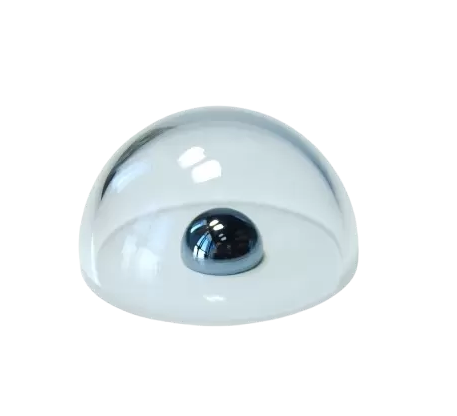
1. What a Super Hemisphere Dome Actually Is
A super hemisphere dome is not just a standard curved glass cover. It is a precisely engineered optical element with a carefully controlled hemispherical (or near-hemispherical) geometry designed to maintain optical transmission while providing environmental protection.
Compared with general-purpose industrial domes, optical-grade versions must meet significantly stricter requirements, including:
-
High optical homogeneity of the substrate
-
Controlled surface accuracy across the entire curved profile
-
Tight surface quality standards (scratch/dig control)
-
Precise centering and dimensional tolerances
-
Compatibility with optical coatings
-
Stable transmission characteristics in defined wavelength bands
-
Resistance to environmental stress such as pressure, moisture, and abrasion
In many systems, this type of dome acts as the outer optical interface, ensuring that environmental exposure does not compromise internal optical performance.
2. Why This Component Is Important in Optical System Design
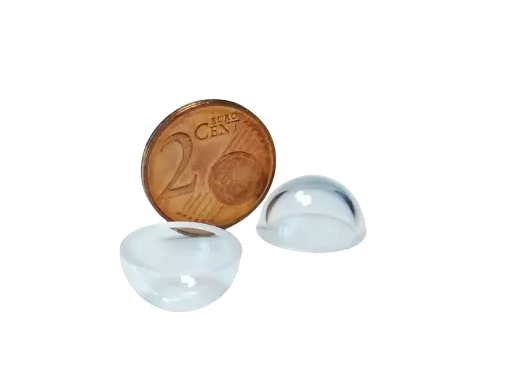
In basic mechanical housings, covers primarily serve as physical protection. However, in optical systems, any external interface must also preserve light propagation behavior.
This is where the super hemisphere structure becomes important. Its geometry allows incoming light to pass through with reduced distortion while maintaining a wide field of view.
In practice, engineers select this type of dome when the system requires:
-
Environmental sealing combined with optical access
-
Wide-angle optical transmission
-
Stable imaging performance across the full field of view
-
High mechanical durability under harsh conditions
-
Compatibility with visible, infrared, or multispectral systems
The key design challenge is balancing protection and optical neutrality, ensuring the dome does not degrade system performance.
3. Difference Between Optical-Grade Domes and Standard Glass Covers
A common misconception is that all domes serve similar functions. In reality, performance differences between standard industrial domes and optical super hemisphere domes can be significant.
3.1 Material Selection
Optical domes use carefully selected materials based on transmission range and environmental conditions. Depending on application requirements, materials may include:
-
Optical-grade glass
-
Fused silica
-
Sapphire
-
Infrared-transmitting materials
Each material is chosen based on wavelength compatibility, thermal stability, and mechanical strength.
3.2 Surface Accuracy Requirements
Unlike standard glass covers, optical domes require precise control of surface geometry. Even minor deviations can introduce:
-
Wavefront distortion
-
Imaging errors
-
Alignment instability
This makes surface precision a critical parameter in design and manufacturing.
3.3 Surface Quality Control
Surface defects such as scratches, pits, or inclusions are far more critical in optical applications. These imperfections can directly affect:
-
Transmission efficiency
-
Scattering levels
-
System reliability under high sensitivity conditions
3.4 Optical Coating Compatibility
Many optical systems require anti-reflection or functional coatings. The dome substrate must be suitable for coating processes without introducing stress or optical degradation.
3.5 Inspection and Quality Assurance
Optical domes are typically validated using high-precision metrology tools to verify:
-
Geometry accuracy
-
Transmission performance
-
Surface integrity
-
Batch-to-batch consistency
4. Typical Application Scenarios
Super hemisphere domes are widely used in systems where optical components must operate reliably in harsh or uncontrolled environments.
Infrared Imaging Systems
Used as external optical interfaces in thermal detection systems, where material transmission properties in IR bands are critical.
Electro-Optical Systems
Applied in tracking, surveillance, and sensing platforms requiring wide field-of-view protection.
Aerospace and Defense Systems
Used in environments with extreme mechanical stress, temperature variation, and environmental exposure.
Marine and Outdoor Optical Equipment
Protects optical systems from moisture, dust, wind, and sand while maintaining transmission quality.
Industrial and Scientific Optics
Used in imaging and measurement systems requiring stable optical paths under operational stress.
5. Key Technical Factors for Selection
When evaluating a super hemisphere dome, several engineering parameters should be carefully reviewed:
-
Material selection: must match wavelength and environmental requirements
-
Surface accuracy: affects wavefront stability and imaging precision
-
Surface quality: determines scattering and transmission losses
-
Coating options: anti-reflection or protective coatings may be required
-
Thickness design: impacts both mechanical strength and optical behavior
-
Dimensional tolerances: must match housing and optical alignment requirements
-
Testing capability: supplier should provide full optical inspection data
6. Manufacturing Complexity
From a production standpoint, super hemisphere domes are challenging components due to the combination of:
-
Complex 3D curved geometry
-
Strict optical performance requirements
-
High surface finish standards
-
Tight dimensional control requirements
Key manufacturing difficulties include:
-
Maintaining uniform curvature accuracy across the full surface
-
Achieving high-quality polishing without localized distortion
-
Controlling edge transitions and thickness variation
-
Ensuring consistent coating performance on curved surfaces
-
Maintaining repeatability across production batches
Because of these challenges, manufacturers with strong optical engineering capabilities are typically required.
7. Supplier Selection Considerations
When sourcing a super hemisphere dome, technical communication with the supplier is often as important as the specification itself.
A qualified supplier should be able to support:
-
Material recommendation based on application
-
Manufacturability assessment for custom designs
-
Defined tolerance capabilities
-
Surface quality grading options
-
Coating process compatibility
-
Inspection and measurement documentation
-
Batch consistency control strategies
-
Integration support with optical assemblies
Many dome projects are not off-the-shelf products but customized optical components requiring engineering collaboration.
Conclusion
A super hemisphere dome is far more than a protective enclosure. It is an optical-grade structural element designed to preserve system performance while shielding sensitive components from environmental influence.
Its value lies in the integration of:
-
Optical engineering
-
Material science
-
Precision manufacturing
-
Environmental durability
Understanding this distinction is essential for engineers and procurement teams, as treating it like standard glass can lead to performance issues in real optical systems.
For applications requiring high optical precision, environmental resistance, and consistent manufacturing quality, working with experienced suppliers is critical. In this context, manufacturers such as ECOPTIK China provide the engineering capability needed to ensure that both design intent and real-world performance are properly aligned.
https://www.ecoptik.net/
ECOPTIK
About Author
