XC3000T EtherCAT Controller: How Real-Time Control Enhances Smart Laser Automation
4 min read www.raytools.com
RayTools
About Author

A hub for dreamers, thinkers, and creators. – Rince Community
The demand for intelligent laser manufacturing continues to grow as industries require faster production speeds, higher precision, and more flexible processing capabilities. From automotive components and semiconductor manufacturing to medical devices and aerospace parts, laser equipment must achieve consistent performance under increasingly complex production conditions.
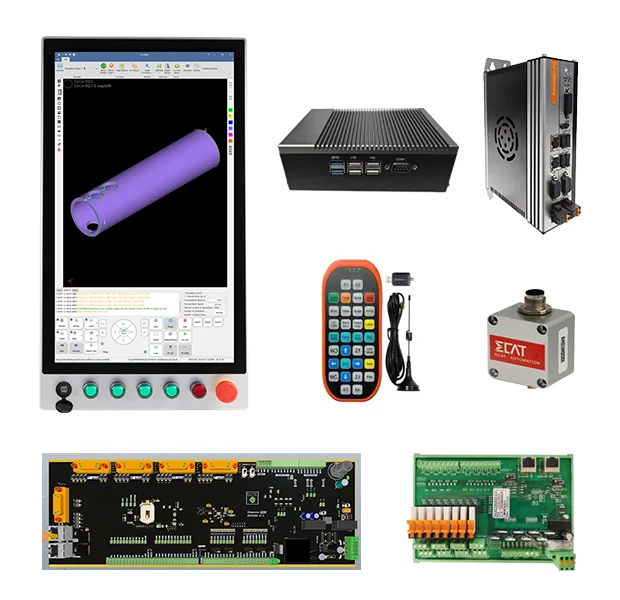
At the center of these systems is the motion control platform. The XC3000T EtherCAT controller provides the real-time communication and synchronized control capabilities required for advanced laser automation, helping equipment manufacturers improve processing accuracy, system integration, and production efficiency.
Unlike conventional controllers designed for simple automation tasks, modern EtherCAT-based controllers are engineered for applications where milliseconds—or even microseconds—can influence final product quality.
Laser manufacturing has evolved from standalone processing machines into highly integrated intelligent systems.
A modern laser workstation may combine:
High-speed servo motors
Precision linear stages
Galvanometer scanners
Laser power controllers
Machine vision systems
Industrial sensors
Robotic handling systems
These subsystems must operate simultaneously with precise timing.
For example, in laser welding of battery components, the movement path, laser power, and positioning accuracy must remain synchronized. Even small timing deviations can affect penetration depth, weld strength, and product consistency.
The controller therefore becomes the central coordination platform that determines overall equipment performance.
The main advantage of the XC3000T EtherCAT controller comes from EtherCAT's deterministic communication architecture.
Industrial automation systems require predictable response behavior. Unlike standard Ethernet communication, which may experience variable delays, EtherCAT provides controlled data exchange designed specifically for real-time applications.
This enables:
Faster command response
Better synchronization between axes
Higher machine throughput
More precise process control
For high-speed laser processing, predictable communication is essential because motion accuracy directly affects processing results.
Manufacturers are continuously seeking ways to increase machine utilization while maintaining quality.
A high-performance controller improves productivity by optimizing:
Motion acceleration profiles
Cycle time
Multi-axis coordination
Process synchronization
Error handling
For example, in laser marking applications, faster communication allows the system to execute complex motion paths more efficiently, reducing processing time per component.
In laser cutting applications, smoother trajectory control allows higher cutting speeds while maintaining edge quality.
The result is improved productivity without sacrificing precision.
Different laser applications require different control strategies.
Micro laser machining demands extremely accurate positioning and stable movement.
Typical applications include:
Electronic component processing
Medical device manufacturing
Precision drilling
Thin material cutting
The controller must support smooth low-speed movement and high-resolution positioning.
Laser welding requires accurate synchronization between movement and energy delivery.
The controller manages motion paths while coordinating external laser control signals, helping maintain consistent weld quality.
Laser cladding involves simultaneous control of multiple parameters, including:
Laser power
Motion speed
Material feeding
Deposition path
Real-time control improves coating uniformity and reduces defects.
Laser additive manufacturing requires accurate layer deposition and repeatable motion execution.
A reliable controller improves:
Layer accuracy
Surface quality
Process stability
Industrial equipment often evolves after initial deployment.
A scalable controller architecture allows manufacturers to add:
Additional servo axes
More I/O modules
New sensors
Vision inspection systems
Automation functions
EtherCAT technology simplifies expansion by reducing wiring complexity and allowing distributed devices to communicate efficiently.
This flexibility helps equipment manufacturers adapt to changing customer requirements without redesigning the entire control system.
Downtime is one of the biggest costs in automated manufacturing.
Modern controllers support improved diagnostics through real-time monitoring of system conditions.
Potential benefits include:
Faster fault identification
Easier maintenance
Reduced troubleshooting time
Improved equipment availability
When integrated with intelligent manufacturing systems, production data can also support predictive maintenance strategies.
A motion controller achieves maximum value when integrated correctly into the complete laser processing system.
Equipment developers need more than hardware—they need solutions that understand laser application requirements.
A technology provider with experience in laser intelligent manufacturing can support applications ranging from precision micro-machining to large-scale automated production.
Expertise across laser cutting, drilling, welding, cladding, hardening, surface treatment, additive manufacturing, and online marking enables better integration between motion control, laser systems, and industrial automation.
This application-focused approach helps manufacturers develop equipment with improved reliability, efficiency, and market competitiveness.
The XC3000T EtherCAT controller provides the real-time communication, synchronized motion control, and integration capability required for modern laser automation systems. By improving multi-axis coordination, processing accuracy, and production efficiency, EtherCAT-based control technology helps manufacturers meet the growing demands of intelligent manufacturing.
As laser equipment continues advancing toward higher precision, faster speeds, and smarter automation, selecting a controller solution backed by strong laser industry expertise becomes a key factor in building reliable and competitive production systems.
www.raytools.com
RayTools