YK3610 CNC Spline Milling Machine: Precision for High-Volume Spline Production
6 min readSpline shafts are widely used in automotive transmissions, industrial gearboxes, hydraulic systems, pumps, and other mechanical power transmission applications. Their performance depends on accurate tooth geometry, consistent spacing, and reliable engagement with mating components. As production volumes increase and component tolerances become more demanding, conventional machining methods may struggle to maintain consistent quality and production efficiency. The YK3610 CNC Spline Milling Machine is designed for spline machining applications that require controlled cutting operations, repeatable positioning, and efficient production. Selecting the right machine, however, requires a closer look at machining principles, workpiece characteristics, tooling compatibility, machine rigidity, and process stability.
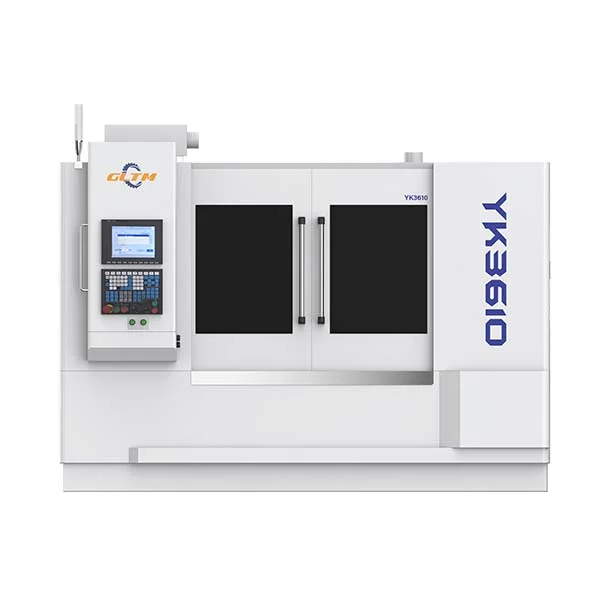
Understanding the Requirements of CNC Spline Milling
Spline machining is different from ordinary shaft turning or general-purpose gear cutting. A spline consists of multiple longitudinal teeth or grooves distributed around a shaft or bore. These features transmit torque while allowing components to connect accurately with mating parts. Depending on the application, spline geometry may involve straight-sided or involute profiles, different tooth counts, pressure angles, and dimensional tolerances.
For example, automotive transmission shafts require reliable engagement under repeated torque loading. Spline shafts used in industrial reducers must maintain dimensional consistency to minimize backlash and uneven load distribution. Hydraulic pump and motor components may require accurate spline profiles to ensure effective torque transfer within compact assemblies.
These requirements make machining consistency particularly important. Errors in tooth thickness, pitch, profile, or concentricity can affect assembly fit and load distribution. If spline dimensions vary between batches, manufacturers may experience increased inspection time, rework, or component rejection. A dedicated CNC spline milling machine helps establish a more controlled production process by coordinating tool movement, workpiece positioning, and cutting operations.
CNC Control and Machining Repeatability
One of the main advantages of CNC spline milling is the ability to coordinate multiple machining movements through programmed instructions. Compared with manual or mechanically indexed operations, CNC control can improve positioning repeatability and reduce operator-dependent variations.
In spline production, accurate synchronization between the cutting tool and workpiece is essential. The machine must maintain the required relationship between tool rotation, workpiece rotation, and feed movement throughout the cutting cycle. Any deviation in synchronization can affect tooth spacing and profile accuracy.
A CNC-controlled machining process also makes it easier to reproduce established production parameters. Once a machining program has been verified, the same process settings can be applied to subsequent workpieces, subject to appropriate setup verification and tool condition management. This is particularly useful for manufacturers producing multiple batches of the same spline component or handling different workpiece specifications.
When evaluating the YK3610 CNC Spline Milling Machine, buyers should examine its CNC configuration, axis coordination, positioning repeatability, and programming flexibility. These factors determine how effectively the machine can handle different spline geometries and production requirements. The actual achievable accuracy should be confirmed against the manufacturer's technical specifications and sample machining results rather than assumed from the CNC designation alone.
Why Machine Rigidity Matters in Spline Milling
Machine rigidity has a direct influence on machining stability. During milling, cutting forces act on the tool, workpiece, fixtures, and machine structure. If the machine deforms under these forces, the relative position between the cutting edge and workpiece may change, potentially affecting tooth geometry and surface quality.
This becomes more significant when machining harder materials, larger workpieces, or components requiring heavier cutting conditions. Insufficient structural rigidity may also contribute to vibration, accelerated tool wear, and inconsistent machining results.
The machine structure should therefore be evaluated as a complete load-bearing system. The bed, columns, spindle support, worktable, guideways, and workholding arrangement all contribute to overall stability. A rigid structure helps maintain the cutting relationship under load and supports more predictable machining performance.
Wuxi General Machinery Co., Ltd. (GLTM / GLT) applies a double-wall and high-rib plate structural design to the main castings of its CNC machine tools. Finite element analysis is used during structural development to assess rigidity and stability. This engineering approach reflects an important principle in spline machining: accuracy is not determined by the CNC controller alone but by the mechanical structure's ability to maintain stable geometry throughout the cutting process.
Tooling Selection and Workpiece Compatibility
The performance of a CNC spline milling machine also depends on the cutting tool and its compatibility with the workpiece. Tool selection must account for spline profile, module or relevant geometric dimensions, material hardness, cutting conditions, and required surface finish.
Different spline standards and geometries may require different cutter designs. An involute spline, for example, has a different profile requirement from a straight-sided spline. Using an unsuitable cutter can result in incorrect tooth geometry even when the machine's positioning system is functioning correctly.
Workpiece material is equally important. Low-carbon alloy steels, medium-carbon steels, and heat-treated materials have different cutting characteristics. Material hardness affects cutting force, tool wear, and the appropriate cutting parameters. For components that undergo subsequent heat treatment, manufacturers should also consider whether spline machining takes place before or after hardening. The selected process route influences tool selection, dimensional allowance, and final inspection requirements.
Before purchasing equipment, it is useful to prepare representative workpiece drawings and machining requirements. These should include spline type, tooth count, profile dimensions, workpiece diameter, length, material, hardness, tolerance requirements, and expected production volume. A machining trial using actual workpiece samples can help verify tool compatibility, cutting stability, cycle time, and achievable dimensional quality.
Improving Production Efficiency Beyond Cutting Speed
High production efficiency does not simply mean increasing spindle speed or feed rate. In industrial spline manufacturing, overall productivity depends on the entire machining cycle, including loading, alignment, workpiece positioning, cutting, tool changes, inspection, and unloading.
A machine with a stable machining process can reduce the time spent correcting dimensional deviations and adjusting cutting conditions. Repeatable CNC programs also help shorten setup time when switching between established production batches. For manufacturers producing a range of spline components, programming flexibility and convenient setup procedures can be just as important as maximum cutting speed.
Tool life should also be included in production cost calculations. Excessive cutting speed or inappropriate feed conditions may shorten tool life and increase the frequency of tool replacement. Inconsistent tool wear can gradually affect tooth profile and surface quality, making tool inspection and replacement intervals important elements of process control.
A practical productivity assessment should compare actual cycle time, setup time, tool consumption, scrap rate, and equipment availability. These indicators provide a more realistic picture of production performance than nominal machine speed alone.
Applications Across Automotive and Industrial Manufacturing
The YK3610 CNC Spline Milling Machine is relevant to manufacturers producing spline components for applications where reliable torque transmission and dimensional consistency are essential. Automotive and motorcycle transmission systems use spline shafts to connect rotating components and transmit power. Industrial reducers require spline interfaces for shafts and coupling assemblies, while pump and hydraulic equipment manufacturers use splined components in compact drive mechanisms.
The machining requirements vary across these sectors. Automotive production often emphasizes repeatability across large batches, while custom machinery manufacturers may prioritize flexibility for different component geometries. Reducer manufacturers may focus on dimensional accuracy and compatibility with mating components. A suitable CNC spline milling solution should therefore match the actual component range and production process rather than relying on a general-purpose performance description.
Choosing the Right YK3610 CNC Spline Milling Machine Supplier
Machine selection should begin with a technical review of the intended parts. Confirm the supported spline types, workpiece dimensions, tooling arrangements, machining accuracy, CNC functions, and production capacity. It is also important to understand the machine's installation requirements, maintenance procedures, spare-part availability, and technical support capabilities.
Wuxi General Machinery Co., Ltd. has developed CNC gear hobbing and spline milling equipment since 2012. Its product range includes the YK3610 and YK3615 spline milling machines, alongside a broad series of CNC gear hobbing and gear cutting equipment. The company has an experienced technical development team, ISO 9001 and CE certifications, and technical patents. Its wider product portfolio also includes gear grinding, gear shaping, gear skiving, gear measuring, and gear chamfering machines, supporting a broader range of gear manufacturing processes.
For manufacturers evaluating a YK3610 CNC Spline Milling Machine, the most reliable purchasing decision comes from matching machine capability with actual production requirements. Structural rigidity, CNC synchronization, tooling compatibility, repeatability, and verified machining results should all be considered together. A properly matched machine can help establish a more consistent spline manufacturing process, improve production efficiency, and support long-term quality control across demanding mechanical transmission applications.
www.gltmachinery.com
Wuxi General Machinery Co., Ltd.
About Author
