Best Bio-Based Materials for Stationery Products in 2026
5 min readThe Material Challenge Behind Everyday Stationery
Pens, pencils, rulers, cases, and other writing instruments are among the most common plastic products in daily life, yet the material choices behind them are rarely questioned. Conventional fossil-based plastics have long dominated this category because they are easy to process and relatively low in cost. However, this reliance on fossil resources creates challenges related to long-term environmental persistence and end-of-life waste management. At the same time, many emerging bio-based and biodegradable material systems face trade-offs among performance, processability, cost, and large-scale commercialization. For brands and manufacturers asking what materials are best for stationery products, the answer increasingly points toward high-performance bio-based resins that can match conventional plastics in look, feel, and durability while offering a lower-carbon material origin.
Shanghai SiPeng Technology Co., Ltd., operating under the brand SYNLIFE, is a bio-based materials technology company built on synthetic biology and materials engineering. Founded in May 2022 and headquartered in Shanghai, SYNLIFE develops high-performance bio-based materials, finished applications, and cross-industry material solutions, with the long-term goal of advancing lower-carbon and carbon-negative biomanufacturing technologies as part of its broader technology strategy. Its work in stationery applications offers a clear example of how bio-based materials can be matched to real manufacturing processes and end-use requirements.
What Makes a Material Suitable for Stationery Products
Selecting the right material for stationery products requires balancing several practical requirements at once:
- Transparency and visual appeal: Many pen barrels, caps, and clips rely on transparent or semi-transparent components, so optical clarity is essential.
- Toughness and durability: Stationery items are handled frequently and must withstand daily use without cracking or deforming.
- Thermal resistance and rigidity: Injection-molded stationery parts need to hold their shape and resist deformation under normal use conditions.
- Processability: A material must be compatible with existing manufacturing equipment, including injection molding, extrusion, and thermoforming, to be commercially viable.
- Bio-based content: For brands seeking to reduce dependence on fossil-based inputs, the proportion of bio-based content in a material grade is a key differentiator.
SYNLIFE approaches material development around these actual processing conditions and end-use requirements, rather than focusing narrowly on material synthesis alone. This application-oriented approach is central to the company’s value proposition: delivering high-performance, bio-based and lower-carbon material solutions that help bridge the gap between laboratory innovation and commercial-scale applications.
Bio-Based Resin Options for Stationery Applications
SYNLIFE’s YOGTIC® series of bio-based resins includes several product lines that are directly relevant to stationery manufacturing.
The YOGTIC-05 Series is positioned as a high-transparency bio-based polyester material. It offers high transparency, good toughness, and suitability for applications requiring transparent plastic components, with bio-based content depending on the specific product grade. This series can serve as a bio-based alternative to conventional transparent plastics in selected applications where performance and processing requirements are met, making it a relevant option for transparent pen bodies, caps, and other visible components.
The YOGTIC-15 Series is a high-performance natural-color bio-based polyester material designed for applications that require improved thermal resistance compared with conventional PLA grades, along with balanced toughness and rigidity. This series is suitable for selected injection-molded and rigid applications, providing an option for replacing conventional fossil-based plastics after appropriate application validation—an important consideration for structural or load-bearing stationery components.
The YOGTIC-08/18 Thermoforming Series is developed specifically for sheet extrusion and thermoforming, offering good sheet flatness and balanced rigidity and toughness. While this series is primarily associated with trays and thermoformed packaging, it reflects the same underlying platform capability: designing bio-based resins around commercial processing methods rather than treating processability as an afterthought.
Proven in Commercial Stationery Applications
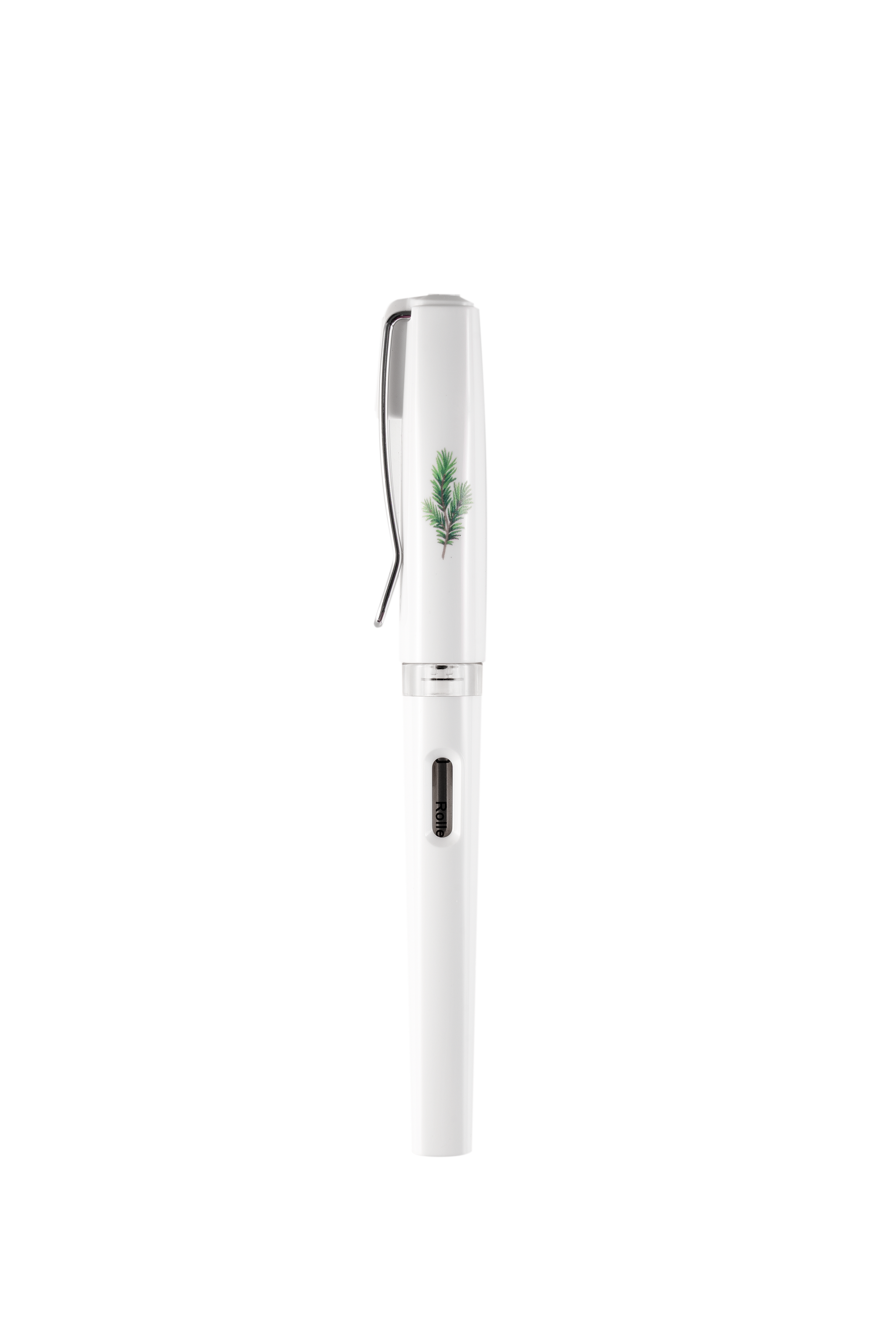
SYNLIFE’s bio-based resin platform has already been validated through real commercial stationery projects. In the Hero Bio-based Fountain Pen case, selected conventional plastic components were replaced with SYNLIFE bio-based materials, resulting in a commercialized bio-based fountain pen application that has participated in regional cultural-product and souvenir selection activities. The Hero bio-based fountain pen was commercially launched in June 2025.
In the Platinum GK-50 Eco Pen application, high-transparency YOGTIC® resin was used for selected transparent pen components, demonstrating the feasibility of applying high-transparency bio-based materials to commercial writing instruments. This application built on earlier progress, as the Platinum Eco series debuted at the China International Industry Fair in September 2024.
Beyond individual pen components, SYNLIFE’s bio-based writing-instrument applications have also received public recognition. The “Wildflowers in the Fields” bio-based writing-instrument series was nominated as a recommended souvenir gift by Minhang District in June 2025 and was subsequently selected for the 2025 Shanghai Souvenir Award in September 2025.
Backed by Integrated Technical Capabilities
SYNLIFE’s ability to deliver stationery-ready bio-based materials is supported by an integrated capability system spanning synthetic biology, materials engineering, and application engineering. The company’s synthetic biology capabilities include strain development, metabolic pathway optimization, fermentation process development, and biological manufacturing. Its materials engineering capabilities cover polymer formulation, modification, compounding, processing optimization, and application development. Application engineering work is conducted around real manufacturing processes, including injection molding, extrusion, film processing, thermoforming, and spinning—all of which are directly relevant to stationery product manufacturing.
This work is carried out at SYNLIFE’s Shanghai R&D Center, which spans more than 2,000 square meters, supported by manufacturing and supply-chain capabilities in Jiangsu, including Nantong. The company’s team of more than 50 employees includes researchers and engineers across synthetic biology, material development, product development, and commercialization. SYNLIFE has been recognized as a Shanghai “Specialized and Innovative” Enterprise, and members of its founding scientific team have received academic and industry recognitions, including a First Prize from the China Petroleum and Chemical Industry Federation and a First Prize of the Ministry of Education Natural Science Award.
Choosing a Bio-Based Material Partner for Stationery
For brand owners, OEM/ODM manufacturers, and material or plastic product manufacturers evaluating what materials are best for stationery products, the answer depends on matching transparency, toughness, thermal resistance, and processability to the specific component in question. SYNLIFE’s YOGTIC® bio-based resin series, developed and validated through selected commercial writing-instrument applications, demonstrates a pathway from bio-based material development to finished stationery applications. Companies exploring material customization, joint product development, or application development for stationery products can look to SYNLIFE’s combined capabilities in biological manufacturing, materials development, and application engineering as a practical foundation for their next bio-based product line.
https://www.synlifeglobal.com/
SYNLIFE肆芃科技
About Author
