Split-Type RFID Lock vs. Integrated RFID Lock: Key Differences
8 min readAs hotels, serviced apartments, offices, and other commercial properties move away from traditional mechanical keys, RFID electronic locks have become an increasingly popular access control solution. They provide contactless access, flexible credential management, and a more modern alternative to conventional door hardware.
However, choosing an RFID lock is not simply a matter of deciding whether to use RFID technology. Buyers also need to consider the physical structure of the lock. Two common configurations are the split-type RFID lock and the integrated RFID lock.
At first glance, these two designs may appear similar because both can support RFID card access and electronic locking functions. In practice, however, their construction, appearance, installation requirements, maintenance characteristics, and suitability for different projects can vary significantly.
For hotel owners, hospitality project contractors, distributors, architects, and purchasing managers, understanding these differences can make it easier to select the right RFID electronic lock for a specific application.
This article compares split-type and integrated RFID locks in detail, explains their respective advantages and limitations, and provides practical guidance for choosing between them.
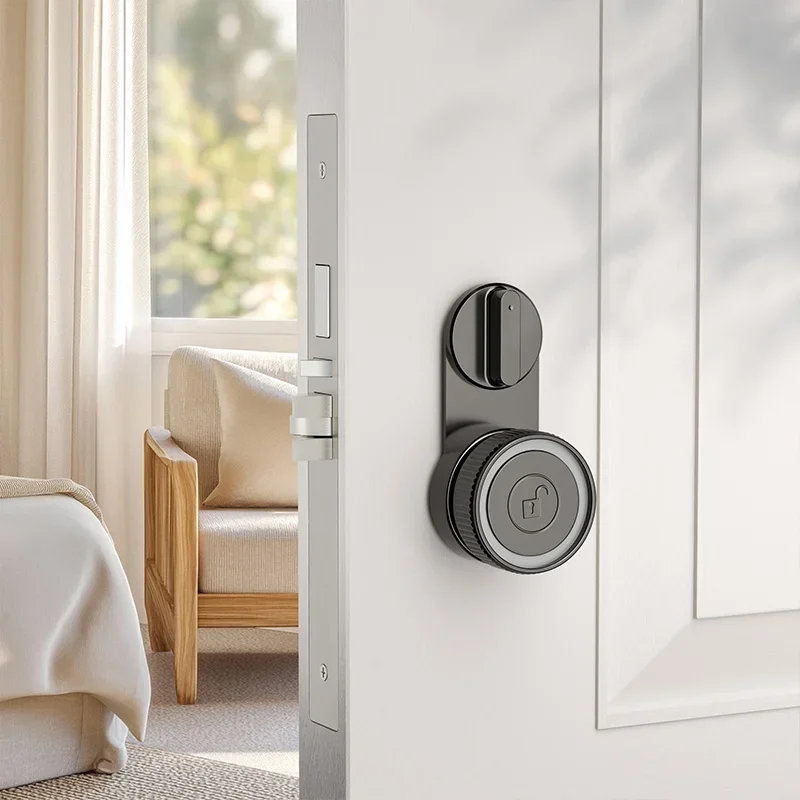
What Is a Split-Type RFID Lock?
A split-type RFID lock is an electronic door lock in which the exterior and interior components are designed as separate assemblies.
The exterior section generally includes the RFID card reader, handle, decorative panel, and other access-related components. The interior section may contain the interior handle, battery compartment, control components, and associated hardware.
Unlike a traditional mechanical lock where the entire mechanism is often designed as one compact assembly, the split-type structure distributes the components across the two sides of the door.
This design is particularly common in hotel room applications because it can combine electronic access functionality with a modern and relatively flexible appearance.
A typical split-type RFID hotel lock may support:
-
RFID card access
-
Mechanical emergency key access
-
Automatic or motorized unlocking
-
Low-battery warning
-
Multi-level access permissions
-
Hotel management system compatibility
-
Optional wireless communication
-
Different exterior finishes
The exact functions depend on the manufacturer and model.
What Is an Integrated RFID Lock?
An integrated RFID lock combines the primary electronic and mechanical components into a more unified lock assembly.
The RFID reader, handle, and decorative housing are usually designed as a coordinated unit. From the outside, this can create a more visually integrated appearance.
Integrated RFID locks are used in hotels, offices, apartments, residential buildings, and other access control applications.
Depending on the model, an integrated RFID door lock may also provide:
-
RFID card unlocking
-
PIN code access
-
Mobile access
-
Mechanical key override
-
Battery-powered operation
-
Access records
-
Bluetooth connectivity
-
Centralized management
The specific configuration varies from product to product, so buyers should evaluate actual specifications rather than assuming that every integrated lock provides the same features.
Split-Type vs. Integrated RFID Lock: The Basic Difference
The most fundamental difference is the physical architecture.
A split-type RFID lock separates the interior and exterior assemblies, while an integrated RFID lock uses a more unified housing structure.
This structural difference can influence several aspects of a project, including:
-
Door appearance
-
Installation
-
Maintenance
-
Component arrangement
-
Design flexibility
-
Replacement requirements
-
Hotel room aesthetics
-
Compatibility with existing doors
However, neither structure is automatically better than the other.
The appropriate choice depends on the property's requirements, door configuration, budget, and desired user experience.
1. Design and Appearance
Appearance is an important consideration for hospitality projects.
Hotel door hardware is part of the overall interior design. Guests interact with the door lock every time they enter or leave their room, so the lock can influence their perception of the room and the hotel.
A split-type RFID lock generally provides more separation between the exterior and interior components. This can create a streamlined appearance while giving manufacturers greater flexibility when designing the reader and handle assembly.
For example, a hotel may choose a particular exterior finish to match:
-
Door hardware
-
Room numbers
-
Interior decoration
-
Lighting fixtures
-
Furniture
-
Other metal accessories
An integrated RFID lock, by contrast, tends to present a more unified appearance.
Which looks better?
There is no universal answer.
A split-type design may be preferable for modern hotels that want a more distinctive door hardware appearance, while an integrated design may work better for properties that prefer a simple, unified look.
For large hotel projects, it is worth requesting physical samples before making a bulk purchase.
2. Installation Requirements
Installation is another important difference.
A split-type RFID lock has separate interior and exterior components. During installation, these components must be correctly aligned and connected with the lock body and internal hardware.
This means installers need to pay attention to:
-
Door thickness
-
Lock body dimensions
-
Mounting holes
-
Spindle alignment
-
Cable routing
-
Interior and exterior component positioning
-
Door opening direction
An integrated RFID lock can sometimes provide a more straightforward installation structure because its components are designed as a unified assembly.
However, installation difficulty ultimately depends on the specific product.
A well-designed split-type hotel RFID lock can be relatively easy to install, while a poorly designed integrated model may still require complicated adjustments.
Therefore, buyers should evaluate the installation instructions and actual door compatibility instead of judging installation difficulty purely by lock structure.
3. Door Compatibility
Door compatibility is one of the most important factors when purchasing an RFID electronic lock.
Hotels may use doors made from:
-
Solid wood
-
Engineered wood
-
Metal
-
Fire-rated materials
-
Composite materials
-
Other specialized constructions
Door thickness can also vary between properties.
A split-type RFID lock may offer flexible installation options for certain hotel door configurations, but the compatibility depends on the lock body and mounting system.
Before ordering, buyers should confirm:
Door Thickness
Make sure the lock is suitable for the actual door thickness.
Lock Body
Check whether the supplied lock body fits the door preparation.
Backset
The distance between the edge of the door and the center of the lock cylinder or spindle needs to be compatible.
Mounting Dimensions
Existing holes and mounting positions should match the new lock wherever possible.
Door Opening Direction
Some locks are designed for specific handing configurations, while others can support both directions.
For large hospitality projects, confirming these details before bulk production can prevent expensive installation problems later.
4. RFID Access Technology
From an access technology perspective, both split-type and integrated RFID locks can use similar RFID systems.
Depending on the product, they may support:
-
125 kHz RFID cards
-
13.56 MHz cards
-
MIFARE cards
-
Other contactless credentials
Therefore, the difference between split-type and integrated RFID locks is primarily structural, not necessarily technological.
For example, a split-type hotel lock and an integrated hotel lock may both use 13.56 MHz RFID cards.
What matters is whether the RFID technology matches the hotel's existing access control infrastructure.
If a hotel already has a card encoding system, buyers should confirm that the new locks are compatible with the same card technology and management software.
5. User Experience
Guests expect hotel access to be simple.
An RFID card system allows users to unlock a door without inserting a mechanical key. The guest simply presents the authorized card near the reader.
Both split-type and integrated RFID locks can provide this experience.
The differences are more likely to come from the design of the reader, handle, feedback mechanism, and overall ergonomics.
A well-designed hotel RFID lock should make it easy for users to:
-
Locate the card reader.
-
Present the RFID card.
-
Receive confirmation that access has been granted.
-
Operate the handle.
-
Enter the room smoothly.
The reader should also provide clear feedback through indicators such as lights or sounds.
This may seem like a small detail, but in hotels with hundreds of daily guest interactions, good user experience can make a meaningful difference.
6. Maintenance and Serviceability
Hotel locks operate frequently and are exposed to continuous use.
Over time, components such as handles, batteries, electronic boards, and mechanical parts may require inspection or replacement.
A split-type structure can provide flexibility in how different components are arranged and serviced. Depending on the design, technicians may be able to access certain components without replacing the entire lock assembly.
Integrated locks can also be designed for easy maintenance, but the service process depends heavily on the manufacturer's engineering approach.
When evaluating an RFID electronic lock, buyers should ask suppliers:
-
Can the battery be replaced easily?
-
Can the handle be replaced separately?
-
Are electronic components available as spare parts?
-
How are firmware updates performed?
-
Can individual components be repaired?
-
What is the expected service life?
-
Is technical support available after installation?
These questions are particularly important for large hotels where replacing complete locks can be expensive and disruptive.
7. Battery Management
Most wireless hotel RFID locks use batteries rather than permanent wired power.
This means battery life is a critical consideration regardless of whether the lock is split-type or integrated.
Hotel buyers should evaluate:
-
Number and type of batteries
-
Expected battery life
-
Number of openings per battery cycle
-
Low-battery alerts
-
Emergency power options
-
Mechanical key override
-
Battery replacement procedure
For example, a hotel with 300 rooms could potentially have hundreds of battery-powered locks operating simultaneously.
A small improvement in battery performance or maintenance efficiency can therefore translate into significant operational savings over time.
A reliable electronic hotel door lock should provide adequate warning before the battery becomes critically low.
8. Security
Security should not be evaluated based solely on whether the lock is split-type or integrated.
Both designs can be engineered with strong security features.
Important factors include:
-
RFID credential technology
-
Encryption and authentication
-
Mechanical lock body
-
Anti-tampering features
-
Access permission management
-
Audit records
-
Emergency unlocking
-
Unauthorized card protection
The mechanical structure is also important.
A sophisticated RFID reader does not compensate for a weak mechanical lock body.
For this reason, hotel buyers should evaluate the entire locking system rather than focusing only on the electronic reader.
9. Emergency Access
Electronic access systems need a reliable backup method.
Battery depletion, electronic malfunction, or unexpected system problems can occur.
Many hotel RFID locks therefore include a mechanical key override or another emergency opening method.
This is particularly important in hospitality because guests cannot be expected to understand complex troubleshooting procedures.
A professional RFID hotel door lock should provide an emergency access solution that is secure but practical for authorized hotel personnel.
When comparing split-type and integrated models, buyers should examine how the emergency cylinder is positioned and protected.
Final Verdict: Split-Type or Integrated RFID Lock?
So, which is better: a split-type RFID lock or an integrated RFID lock?
The answer depends on what the project needs.
A split-type RFID lock can be an excellent choice for hotels that place a strong emphasis on modern aesthetics, flexible design, and hospitality-oriented applications. Its separated component structure can provide manufacturers with greater design flexibility and allow the exterior hardware to be tailored to different hotel styles.
An integrated RFID lock, meanwhile, can be a practical choice for projects that prefer a more unified appearance and straightforward product configuration.
Neither design is inherently more secure or more reliable simply because of its structure. The actual performance depends on the RFID technology, electronic components, mechanical lock body, manufacturing quality, software, installation, and long-term support provided by the manufacturer.
For hotel owners and B2B buyers, the best approach is to evaluate the complete system. Consider door compatibility, RFID card technology, battery performance, security, access management, emergency unlocking, installation, maintenance, customization, and supplier support before making a final decision.
Ultimately, the right RFID electronic lock should fit both the physical door and the operational needs of the property. Whether you choose a split-type or integrated design, selecting a reliable hotel RFID door lock from an experienced manufacturer can help create a secure, convenient, and durable access control solution for modern hospitality environments.
www.coconano.net
coconano
About Author
